Digital Forms in Real Estate: How the Industry is Finally Going Paperless
The real estate industry is in the middle of a long-overdue digital transformation. According to Deloitte's 2024 Commercial Real Estate Outlook, 61% of real estate firms still rely on outdated technology ... but that's rapidly changing! What caught our attention most is that customers spend an average of 6.5 hours filling in various forms during a typical real estate transaction. That's almost a full workday just on paperwork.
We're seeing the AI real estate market explode from $222.65 billion in 2024 to an expected $303.06 billion in 2025, representing a 36.1% growth rate. This isn't just hype (although let's be honest, it's partially hype as well), it's real estate professionals realizing that digital forms and AI-powered tools can save them countless hours while improving accuracy and client experience.
In this guide, we'll look at how digital forms are transforming real estate workflows, what tools professionals are using today, and how AI is making it easier than ever to create custom forms for any property type or transaction.
For a deeper look at every form type agents use across the deal lifecycle, check out our Complete guide to real estate online forms for agents.
How Real Estate Professionals Currently Handle Forms
If you've bought, sold, or rented property recently, you know the drill: mountains of paperwork from start to finish. Listing agreements, disclosure forms, open house sign-in sheets, rental applications, buyer questionnaires, feedback forms ... the list goes on.
Most agents and landlords currently rely on a mix of approaches. Some still use paper forms and manual data entry (yes, really). Others have upgraded to static PDF templates that need to be downloaded, filled out by hand or with a PDF editor, then scanned and emailed back and forth. The more tech-savvy professionals use generic form builders like Google Forms, Typeform, or Jotform.
According to the National Association of Realtors, about 80% of real estate firms now use electronic contracts and forms. That's progress, but here's the catch: these digital forms are often just digitized versions of paper forms. They still require manual setup, field-by-field customization, and don't automatically adapt to different property types or transaction needs.
The reality is that generic form builders weren't designed with real estate in mind. When you need to create an open house sign-in sheet for a luxury listing, it shouldn't take the same amount of time as building a basic contact form from scratch. Yet that's exactly what happens with traditional form builders. You start with a blank slate every time, manually adding fields, adjusting layouts, and trying to make it look professional.
How AI is Changing Real Estate Forms
This is where AI-powered form generation changes the game. Instead of spending 30 minutes clicking through a form builder interface, you can describe what you need in plain English and have a custom form ready in seconds.
Here's a real example: Let's say you're hosting an open house this weekend. With a traditional form builder, you'd log in, create a new form, add fields for name, phone, email, agent status, buying timeline, pre-approval status, property interests, and any other details you want to capture. Then you'd fiddle with the layout, add your branding, and figure out how to share it.
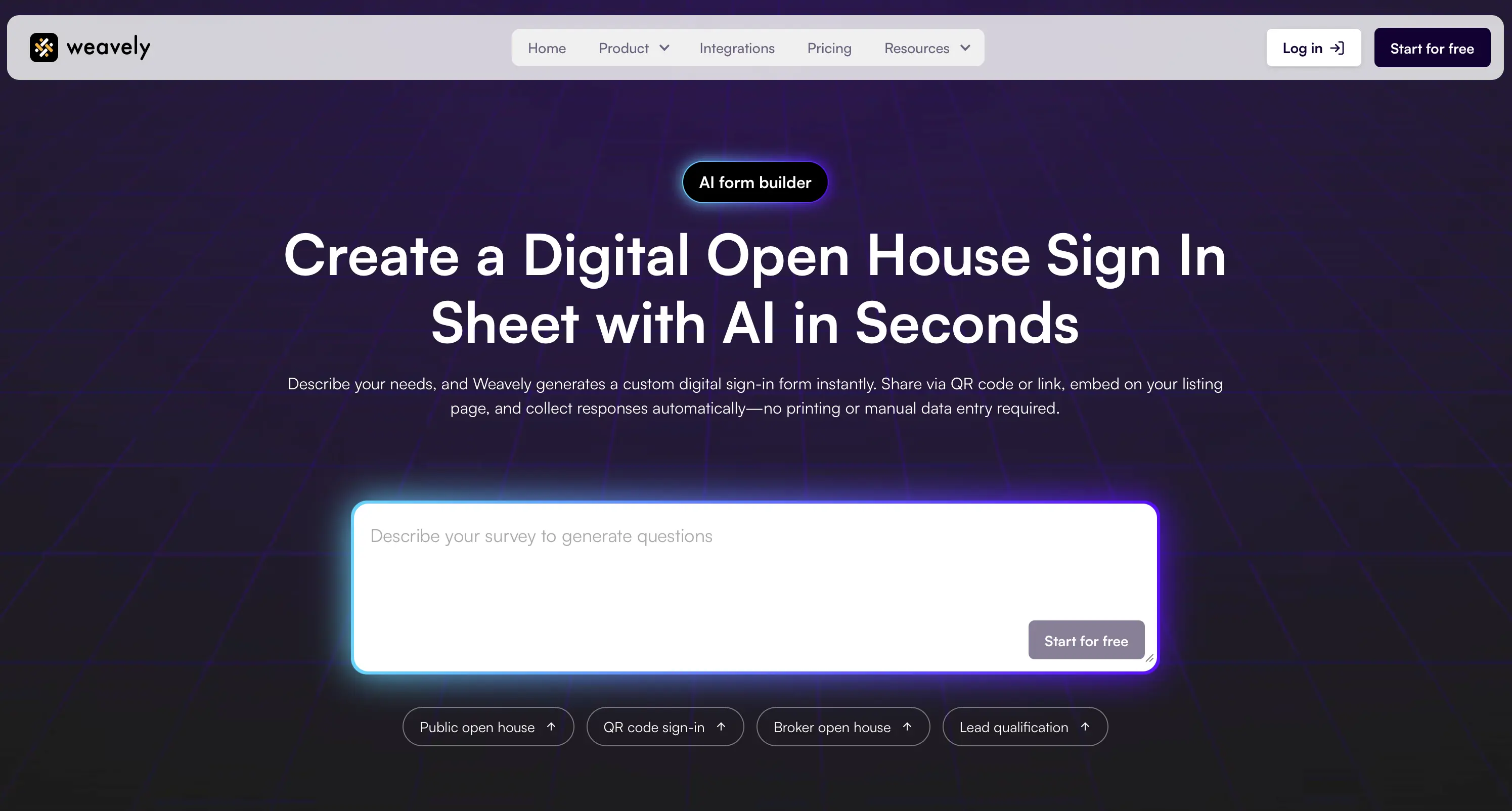
With Weavely's open house sign-in sheet generator, you just say: "Create an open house sign-in sheet that collects visitor contact info, whether they're working with an agent, their buying timeline, and what features they're looking for. Make it clean and professional with space for 20 visitors." Done. The form generates instantly, already formatted and ready to share via link or QR code. Real estate agents can further streamline their workflow by embedding their Weavely form into a digital business card. Instead of carrying paper sign-in sheets, an agent can simply have visitors scan their card to register their interest.
The same goes for rental applications. Instead of downloading a generic template and spending time customizing it for your specific property type (is it residential? Commercial? A room rental?), you can generate a compliant rental application customized for exactly what you're renting. Need to add pet policies for a dog-friendly building? Parking requirements for a condo? The AI adapts the form to your specific needs.
Real estate buyer questionnaires are another perfect use case. Every agent has their own preferred questions for qualifying buyers. Rather than starting from scratch or trying to retrofit someone else's template, you can describe your ideal buyer consultation process and have a questionnaire built for you. You can even create different versions for first-time buyers versus investment buyers.
Once responses start coming in, you can export everything to Google Sheets for easy tracking, or integrate with your CRM system to keep all your lead information organized in one place.
Best Practices for Digital Real Estate Forms
Whether you're using AI-generated forms or traditional tools, there are some key best practices that make a huge difference in response rates and data quality.
Keep it mobile-friendly. More than 60% of real estate searches now start on mobile devices, according to NAR data from 2024. Your forms need to work flawlessly on phones and tablets. Open house visitors should be able to quickly fill out your sign-in sheet on their phone, not struggle with tiny text fields designed for desktop.
Only collect what you actually need. We've seen rental applications that ask for 30+ data points. Unless you're really going to use all that information, you're just creating friction. Focus on the essentials and add optional fields for nice-to-have details.
Be transparent about data usage. Real estate involves sensitive personal information: financial details, employment history, social security numbers. Make it clear how you'll use and protect that data. This builds trust and increases completion rates.
Set up proper follow-up processes. Digital forms make it easy to collect responses, but that's useless if leads sit in your inbox unattended. Create a system for reviewing submissions quickly. Even an automated confirmation email saying "We received your information and will follow up within 24 hours" makes a big difference.
Customize for your market. A buyer questionnaire for luxury waterfront properties should look and feel different from one for first-time homebuyers looking at starter condos. Your forms are part of your brand, make sure they match the level of service you provide.
Ready to Streamline Your Real Estate Paperwork?
Digital forms have moved from nice-to-have to essential for real estate professionals. They save time, reduce errors, and create a better experience for clients and leads. The traditional approach of downloading PDFs or building forms field-by-field simply can't compete with AI-powered generation that creates custom forms in seconds.
Whether you need open house sign-in sheets, rental applications, or buyer questionnaires, there's no reason to spend hours on form creation when you can describe what you need and have it ready instantly. Try our AI real estate form generator and see how much time you can save on your next transaction.
Frequently Asked Questions
What types of digital forms do real estate professionals need most?
The most common real estate forms are open house sign-in sheets, rental applications, buyer questionnaires, property feedback forms, tenant screening applications, maintenance request forms, and listing agreements. Each serves a specific purpose in the property transaction or management process. Digital versions of these forms save time, reduce errors, and make it easier to track and organize information.
Are digital rental applications legally compliant?
Yes, digital rental applications can be fully compliant with Fair Housing laws and state regulations as long as they collect the appropriate information and include required disclosures. Most states allow electronic signatures on rental applications, though some require specific language about background and credit checks. Always verify your local requirements and consider consulting with a real estate attorney to ensure your forms meet all legal standards.
How can real estate agents make open house sign-in sheets more effective?
Effective open house sign-in sheets capture essential contact information while respecting visitors' time. Include fields for name, phone, email, whether they're working with an agent, buying timeline, and key property preferences. Digital sign-in sheets accessed via QR code work better than paper because they're contactless, automatically organized, and easier to follow up on. The key is making it quick, visitors should be able to complete it in under a minute.
What information should be included on a real estate buyer questionnaire?
A comprehensive buyer questionnaire should cover current housing situation, motivation for buying, timeline, budget range, financing status, must-have features, preferred locations, and deal-breakers. For investment buyers, add questions about investment goals, desired ROI, and property management plans. The goal is to understand not just what they can afford, but what they're actually looking for so you can match them with the right properties.
Can I customize digital forms for different property types?
Absolutely. One of the biggest advantages of digital forms, especially AI-generated ones, is the ability to quickly customize for specific property types. A commercial lease application needs different fields than a residential rental. A luxury home buyer questionnaire asks different questions than one for first-time buyers. The best approach is to create templates for your most common property types, then customize from there rather than starting from scratch each time.
How do digital forms integrate with real estate CRM systems?
Most modern digital form tools offer integrations with popular CRM platforms through direct connections or automation tools like Zapier. Real estate forms can typically export data to Google Sheets, which then syncs with most CRM systems. This automation eliminates manual data entry and ensures all lead information flows directly into your sales pipeline where you can track and follow up appropriately.

Tatiana is the Growth Marketing Manager at Weavely, where she's spent nearly four years running marketing end to end. From campaign strategy to the SEO content that brings new readers to the platform. Working day to day on a form builder gives her a front-row seat to what actually makes forms, surveys, and landing pages convert, and that's what she writes about here: practical, tested advice on lead generation and form design. Before Weavely, she led brand and SEO work at Digital Leap and cut her teeth on B2B and B2C content at Ruddy. She's based in Brussels.