Intake forms for massage therapists: how to set up and what to ask
Most massage therapists know they need an intake form, but don't always know exactly what it should contain.
A massage intake form is a clinical screening tool, a consent document, a treatment planning resource, and your clearest protection if a session goes wrong. Sending it to clients before they arrive means you can review their health history in advance, make the most of the session time from the first minute, and have everything documented in writing before any treatment begins.
This guide covers what to include and how to make sure clients actually finish the form before they arrive.
If you're building intake processes more broadly, across different service types, the complete guide to client intake forms is a useful starting point. This article goes deeper specifically for massage therapy.
The core sections every massage intake form needs
1. Basic client information
Name, date of birth, phone number, email address, emergency contact. The date of birth is worth including specifically — it gives you age context that can be relevant to treatment decisions, and it helps distinguish between clients with similar names in your records.
2. Reason for visit and goals
Ask what brought the client in and what they're hoping to get from the session. This is often framed as a single open-text field, but you get better answers if you give clients a prompt: "What areas would you like the therapist to focus on? Is there anything you'd like to avoid?"
Also ask whether this is a maintenance or wellness visit, or whether there's a specific issue (injury recovery, chronic pain, stress management, postnatal care, and so on). The answer shapes how you plan the session before the client arrives.
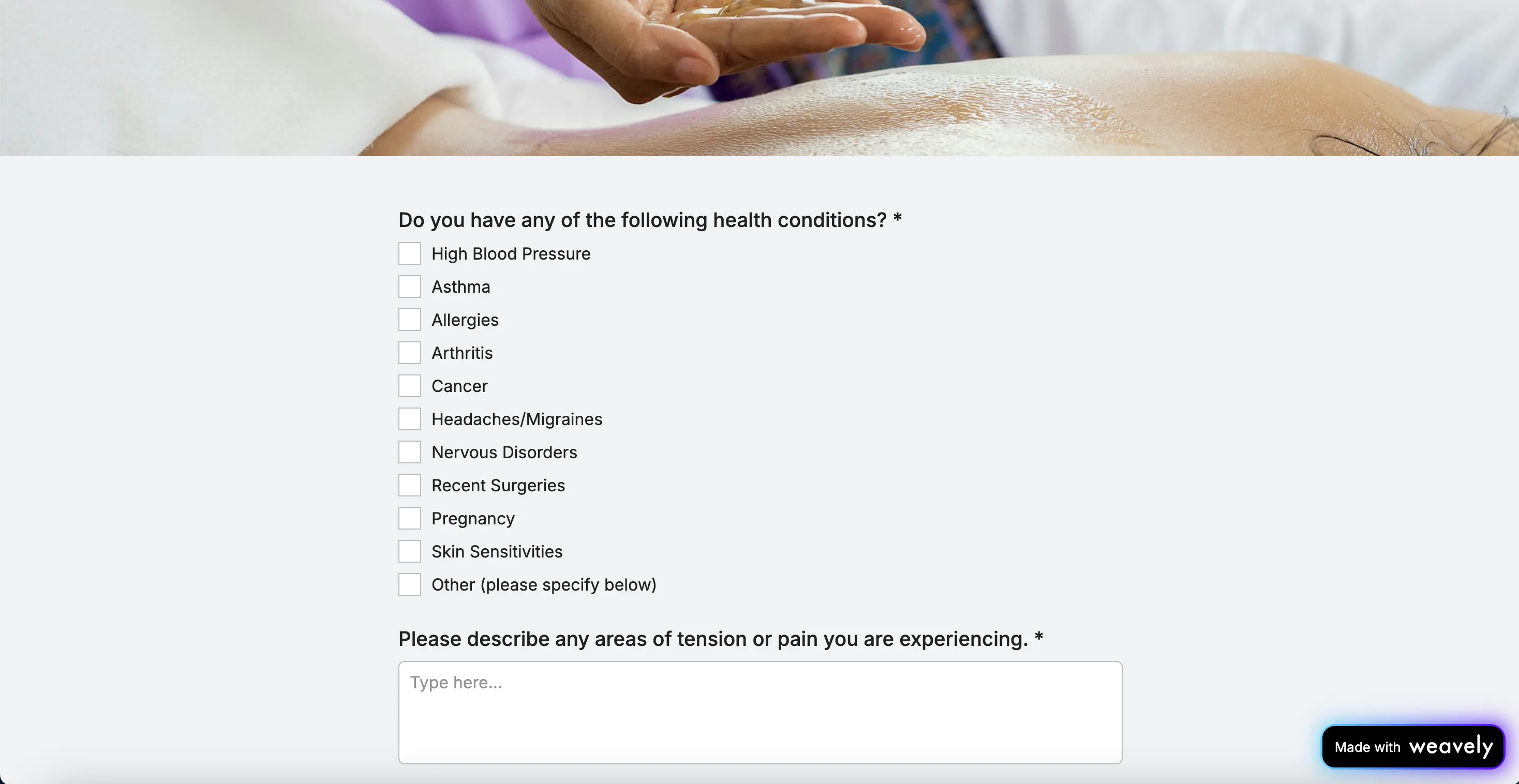
3. Client's health history
This is the section that distinguishes a massage intake form from a general intake form. You need to know about current medications, recent surgeries or injuries, relevant medical conditions, skin conditions, allergies to oils or fragrances, pregnancy status, and any history of blood clots or DVT.
4. Session preferences
Pressure preference (light, medium, firm, or a scale of 1–5). Areas to focus on. Areas to avoid. Whether the client has had massage before. If they have, whether they have feedback from previous sessions, things that worked well or techniques they didn't like.
Draping preferences are worth including explicitly, particularly if your practice works with diverse clientele. Some clients are not aware they have options around draping. Asking normalises it and helps clients feel more in control before they get on the table.
5. Informed consent
The client should acknowledge that they have disclosed all relevant health information, that they understand the nature of the service, that massage is not a substitute for medical care, and that they can stop the session at any time. For clients with significant health histories, some practices also include a liability waiver.
Consent must be documented before every new client's first session. For returning clients, you need a mechanism to capture any changes.
Contraindications your intake form should screen for
Not every condition means massage can't happen — but some require modification, and a few require medical clearance before you proceed.
The most serious red flags are active blood clots or DVT history, uncontrolled hypertension, active fever, contagious illness, and recent surgery on the area being worked. These are situations where you need either medical clearance or to reschedule.
Local contraindications — open wounds, active rash, bruising, recent injection sites — mean you work around the area, not that you cancel the session. Relative contraindications like pregnancy, diabetes, osteoporosis, or cancer treatment mean you modify technique and pressure, ideally with some knowledge of the client's current treatment status.
Your intake form can't diagnose. What it does is give you the information to ask the right questions before the session starts, rather than discovering something important when the client is already on the table.
Getting clients to complete the form before they arrive
Completion rate tends to be higher when the form arrives immediately after a booking confirmation rather than as a separate reminder sent the day before. Clients are most engaged right after booking. Consider sending a link in the confirmation email, with a brief note asking them to complete their health history before their first visit.
Keep the form mobile-friendly. A significant portion of appointment bookings happen on phones, and a form that is hard to navigate on a small screen will see higher abandonment, regardless of how well-designed the questions are.
These days people are overwhelmed with emails, so make sure to explain why filling out the intake form matters, otherwise clients will just ignore it. "Please fill out your health history form before your appointment so we can make the most of your session time" is more effective than just sending a link with no context. It tells the client what the form is for and why completing it in advance benefits them.
Building your massage intake form
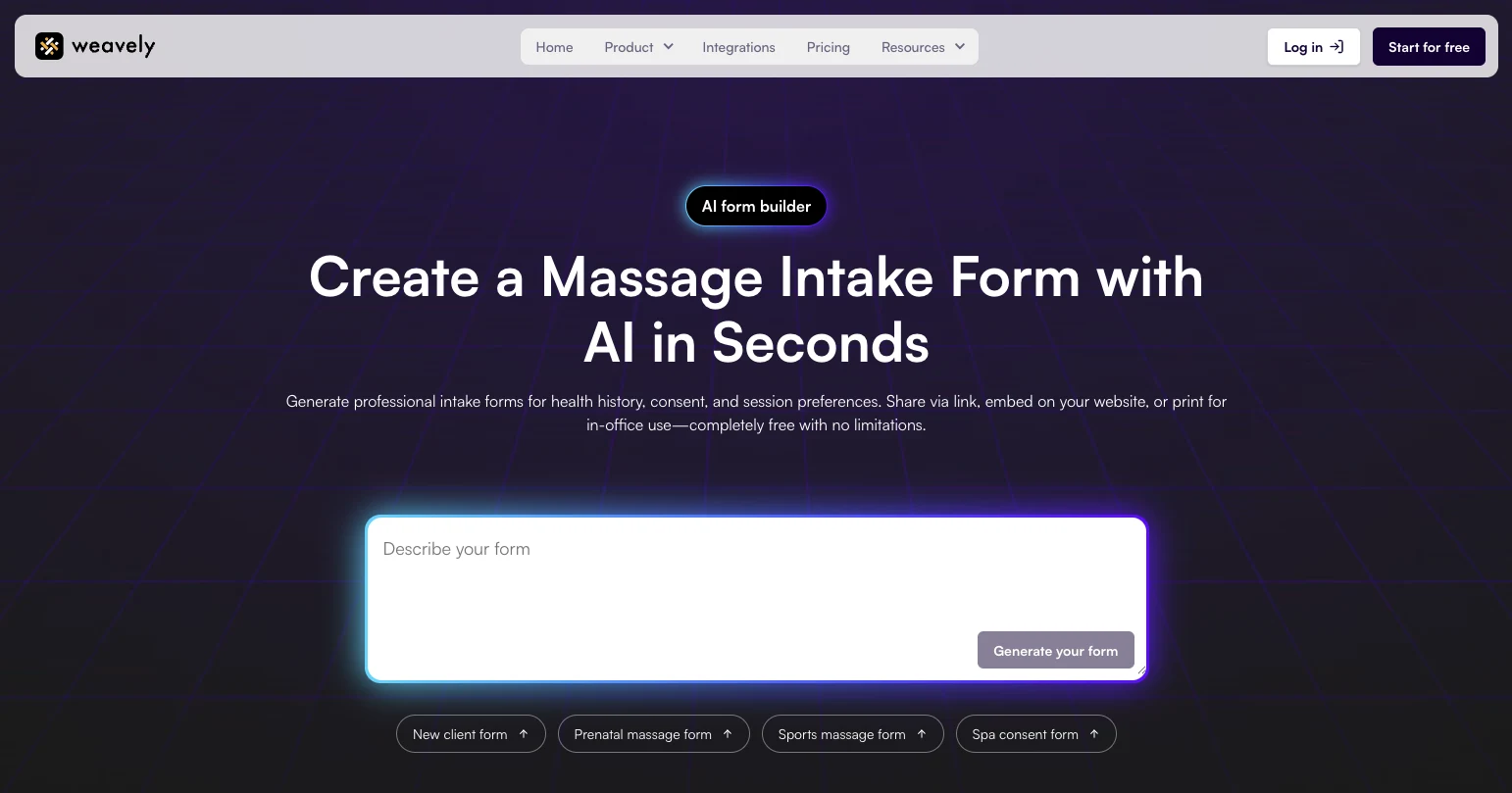
If you're creating a digital intake form from scratch, Weavely lets you generate a massage-specific intake form from a prompt. Describe your practice, and it produces a structured, multi-step form with conditional logic.
The Weavely massage intake form template is also available if you'd prefer to start from a structured base and modify from there.
For practices that need to collect e-signatures for consent and waivers, both are available on the free plan.
Tatiana is the Growth Marketing Manager at Weavely, where she's spent nearly four years running marketing end to end. From campaign strategy to the SEO content that brings new readers to the platform. Working day to day on a form builder gives her a front-row seat to what actually makes forms, surveys, and landing pages convert, and that's what she writes about here: practical, tested advice on lead generation and form design. Before Weavely, she led brand and SEO work at Digital Leap and cut her teeth on B2B and B2C content at Ruddy. She's based in Brussels.