The most useful ChatGPT apps for marketers: automate your workflows
What are ChatGPT apps and how are they different from GPTs?
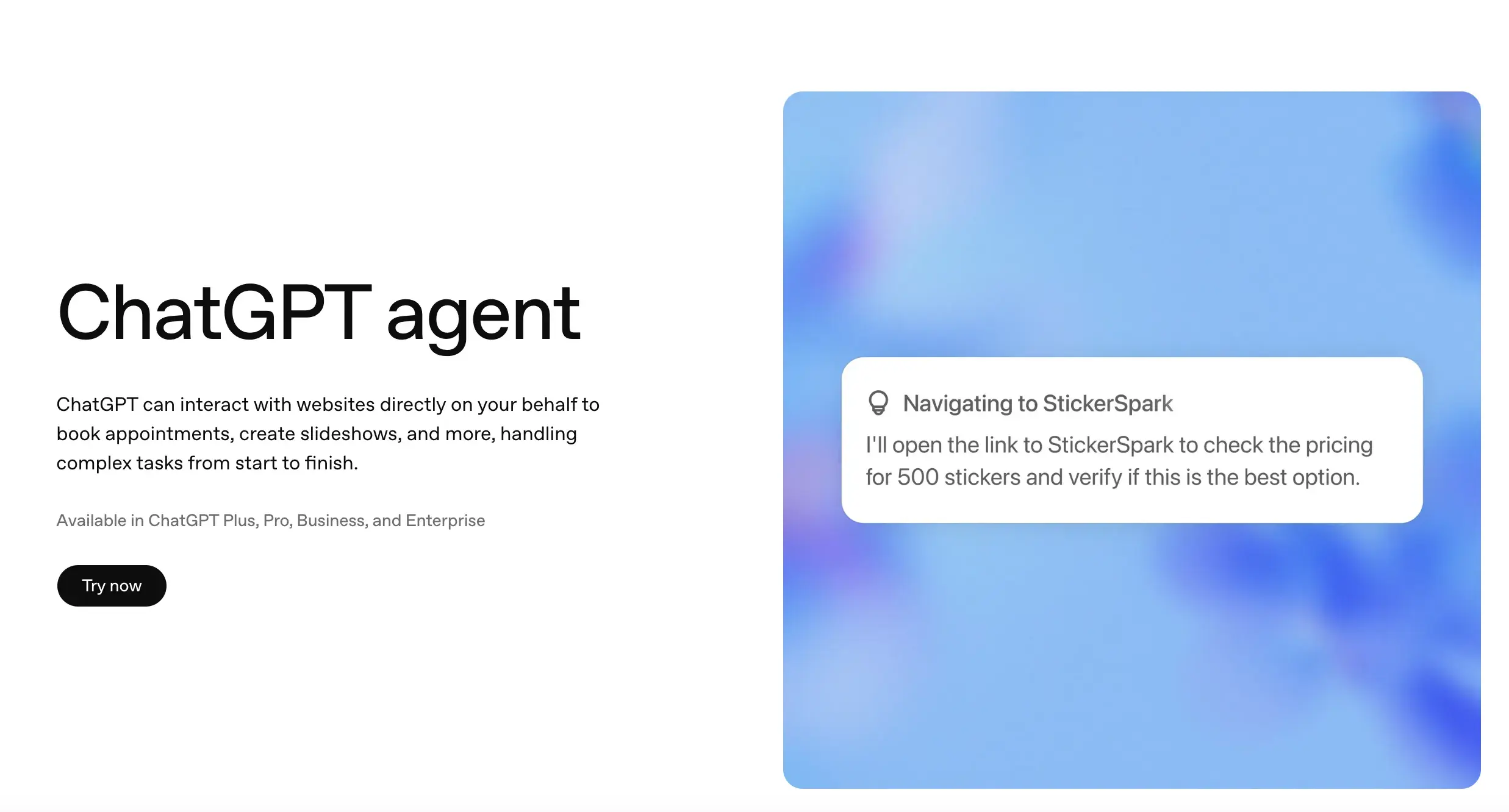
If you used ChatGPT a year or two ago, you probably remember the GPT Store: a directory of custom ChatGPT versions built by developers and enthusiasts, each with a tailored prompt, optional file uploads, and sometimes an external API connection wired in. The idea was good; the execution was messy. Discovery was poor, quality was inconsistent, and most people stopped browsing it after the first week.
Apps are OpenAI's answer to that. It is the same core idea onnecting ChatGPT to external tools but repositioned around professional integrations from real vendors: Ahrefs, Canva, HubSpot, Zapier. Instead of a community marketplace of mixed-quality GPTs, Apps is a curated layer that turns ChatGPT into a hub for the tools you already use. The GPT Store still exists in the background, but Apps is where the momentum has shifted.
The practical difference for marketers: an App is a live connection to an external service. When you use the Ahrefs app inside ChatGPT, you're pulling real-time data from your Ahrefs account — not getting a pre-trained response about SEO. When you use the HubSpot app, you're reading and writing to your actual CRM. It's ChatGPT as a conversational interface layered on top of your existing stack, rather than a standalone tool.
Weavely - Data collection
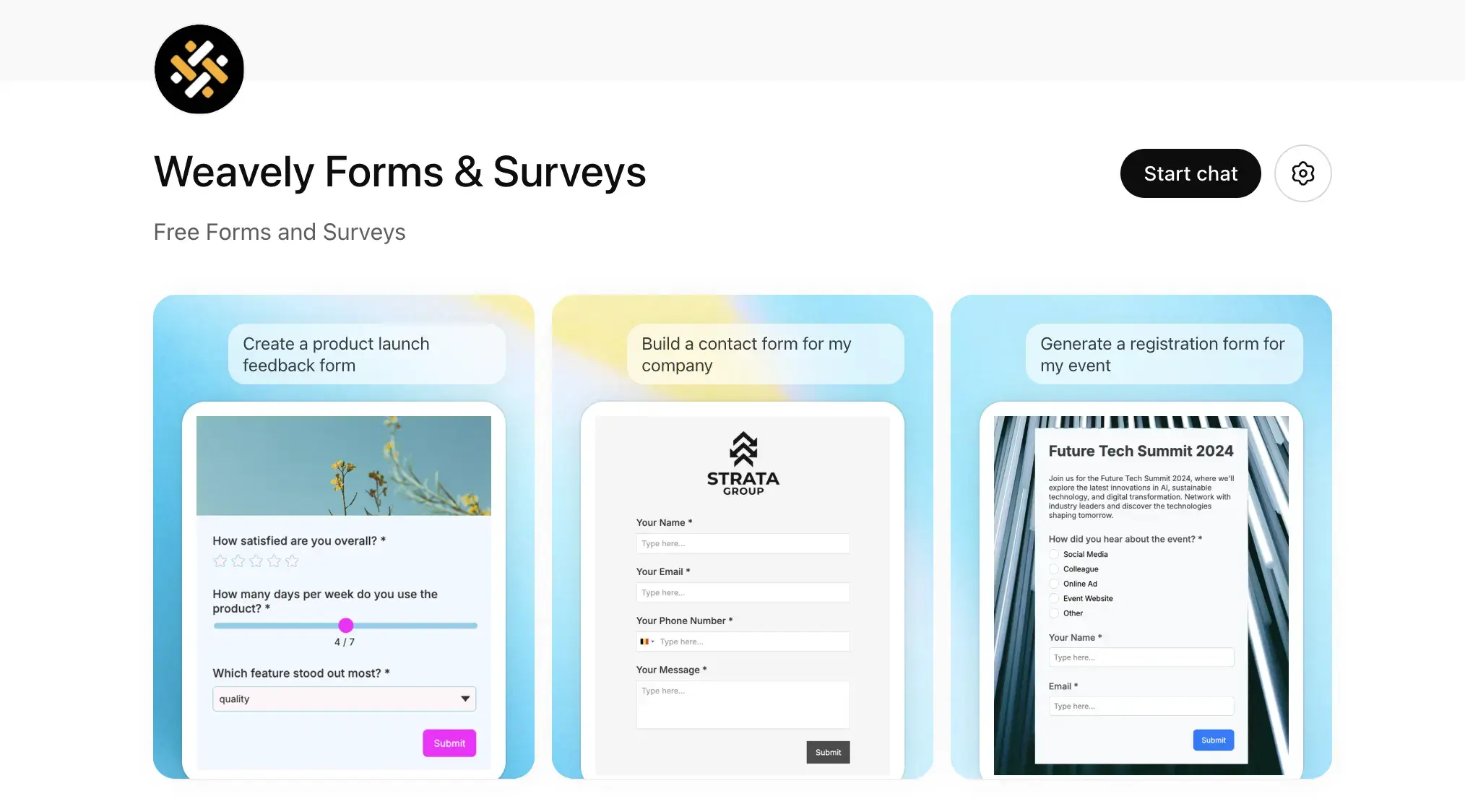
Marketing professionals often need forms, such as contact and registration pages, product feedback surveys, lead qualification quizzes. Setting them up used to take time, but with AI form builders like Weavely, it now takes a single prompt.
Weavely is a fully AI-powered form builder. It lets you describe what you need and generates a complete form in seconds, including multi-step layout, conditional logic, and answer piping, with nothing to configure manually. If you prefer to stay inside ChatGPT, Weavely's native ChatGPT integration means you can build directly from the chat without switching tabs.
The payoff shows up across the entire funnel: gated content downloads, webinar registrations, post-event surveys, client intake forms, payment collection for workshops — all handled in one tool, with native integrations into HubSpot, Airtable, Google Sheets, and Salesforce.
You can start without creating an account. The free plan includes unlimited forms and responses, which is genuinely unusual in this category.
Ahrefs - SEO and GEO
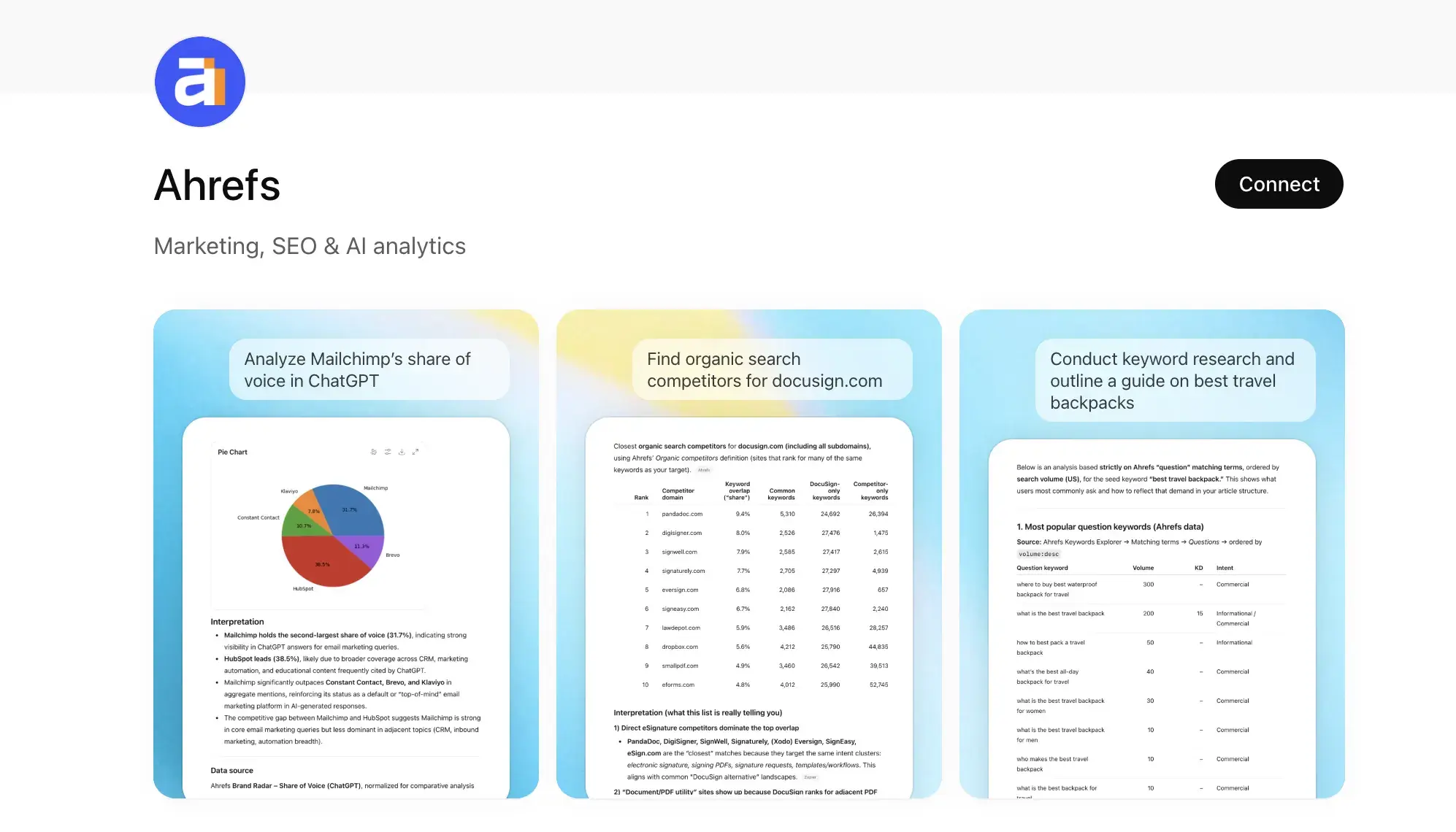
As a marketer, you're most likely familiar with Ahrefs - the go-to tool for serious SEO work. Ahrefs is a complex tool with dozens of features. It involves some learning curve, and some people never use it to its full potential. Connecting Ahrefs to ChatGPT makes it easier to explore more features, as you don't need to get lost in the platform's endless tabs. You can ask ChatGPT anything you'd like to know about your website or the competition, and it will pull the data from Ahrefs, analyse it and give you actionable conclusions.
In practice this means pulling keyword difficulty scores, checking referring domain counts for a prospective backlink partner, or creating a summary of which pages lost rankings this month.
You can query keyword clusters, surface competitor content gaps, and draft an outline in the same session. For teams running regular link outreach or content audits, collapsing those steps into one interface saves a meaningful amount of time each week.
Supermetrics - Marketing analytics
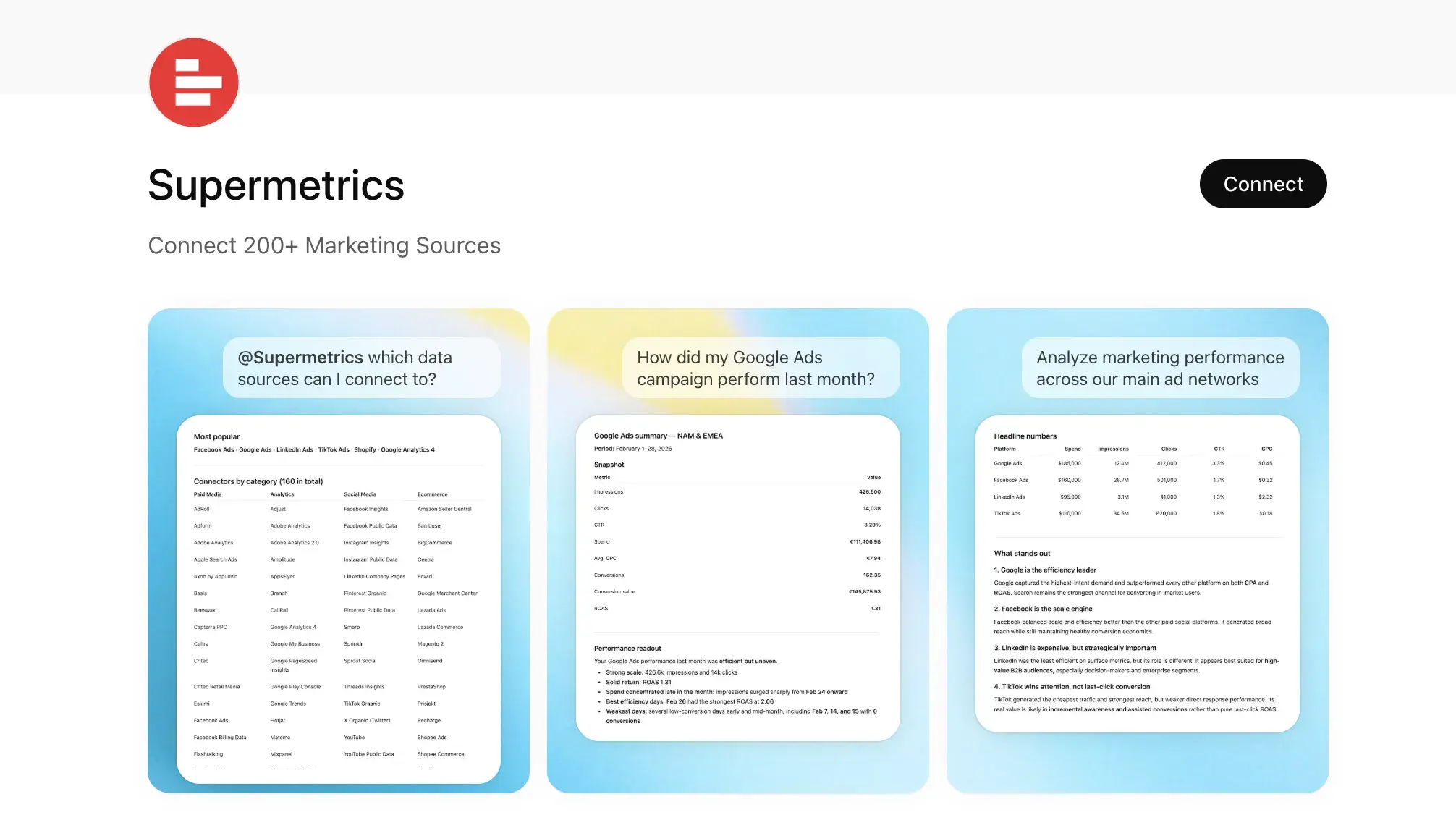
Most marketers spend more time pulling reports than reading them. Supermetrics is a data pipeline tool that connects 150+ marketing platforms like Google Ads, Meta, TikTok, GA4, cleans the data, and delivers it to wherever you work - be it spreadsheets, BI tools, or data warehouses. On its own, the analysis is still on you. But the ChatGPT integration is a game changer for Supermetrics. Instead of exporting CSVs or navigating dashboards, you just ask questions and get answers from your live data.
In practice, you can ask: "Which pages had the highest bounce rate this month?", "How did our paid social perform versus organic last week?", "Were there any unusual traffic drops in the past 48 hours?" ChatGPT pulls fresh data from Supermetrics every time.
For marketers who report regularly to stakeholders or need to diagnose performance issues quickly, this is one of the highest-leverage integrations in the list. You get the analytical depth of a BI tool without needing to build a single dashboard.
Canva - Visual content
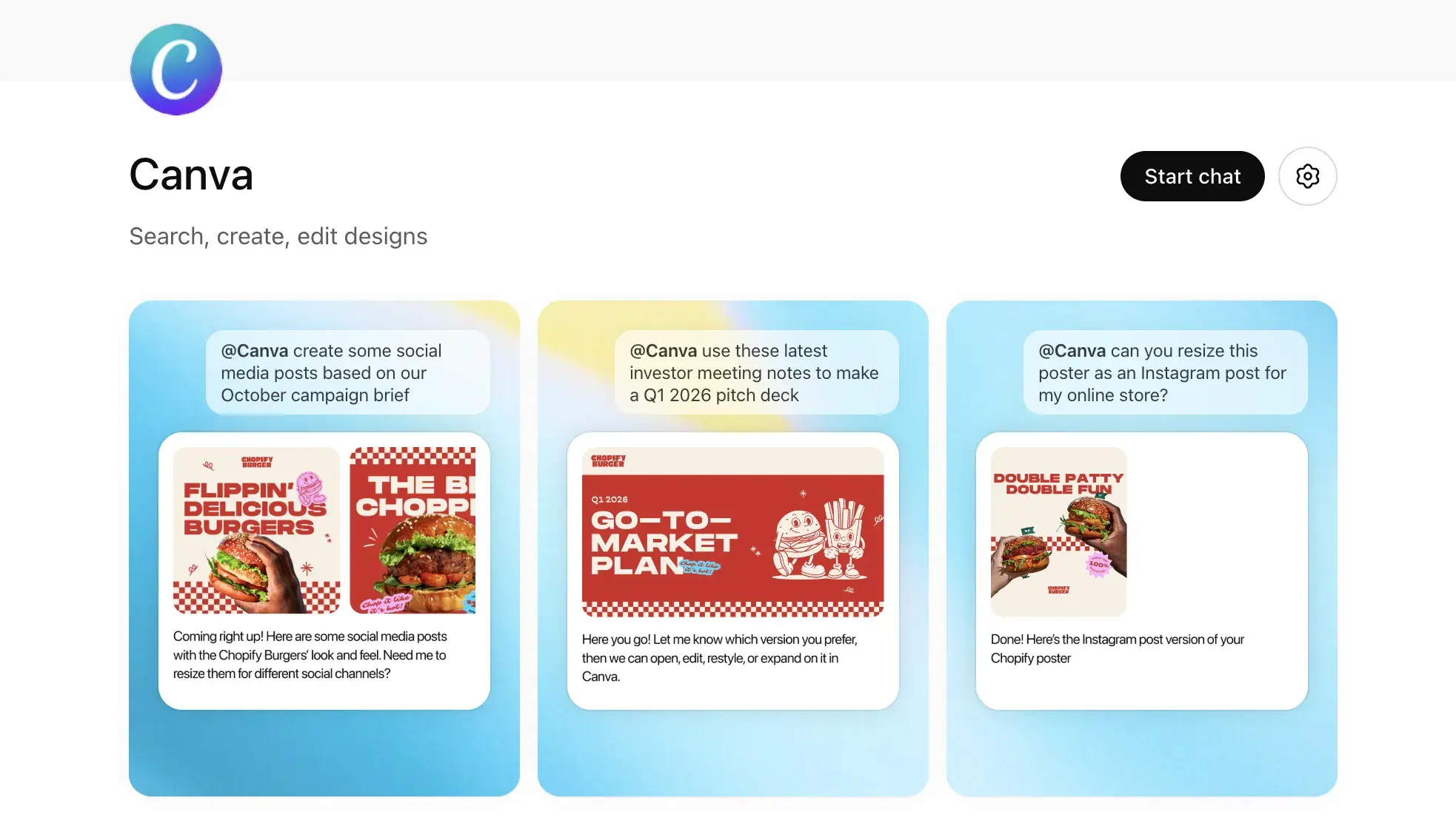
The ChatGPT integration with Canva closes the gap between "idea" and "shareable asset." Marketers are regular Canva users, and are normally used to browsing templates for their designs. Inetgration with ChatGPT changes the game, as it is now much easier to design an asset that looks exactly how you imagined it.
For example, describe the visual you need (a LinkedIn carousel about your latest product update, or a banner for a paid campaign), and Canva generates it directly inside ChatGPT. You can preview the design without leaving the chat, then open it in Canva where every element is fully editable: text, images, layouts, colours. This way, it's not a flat export, it actually comes through as a proper Canva design you can work with immediately.
This integration serves as a great accelerator in your visual assets design workflows!
Lovable - AI app builder
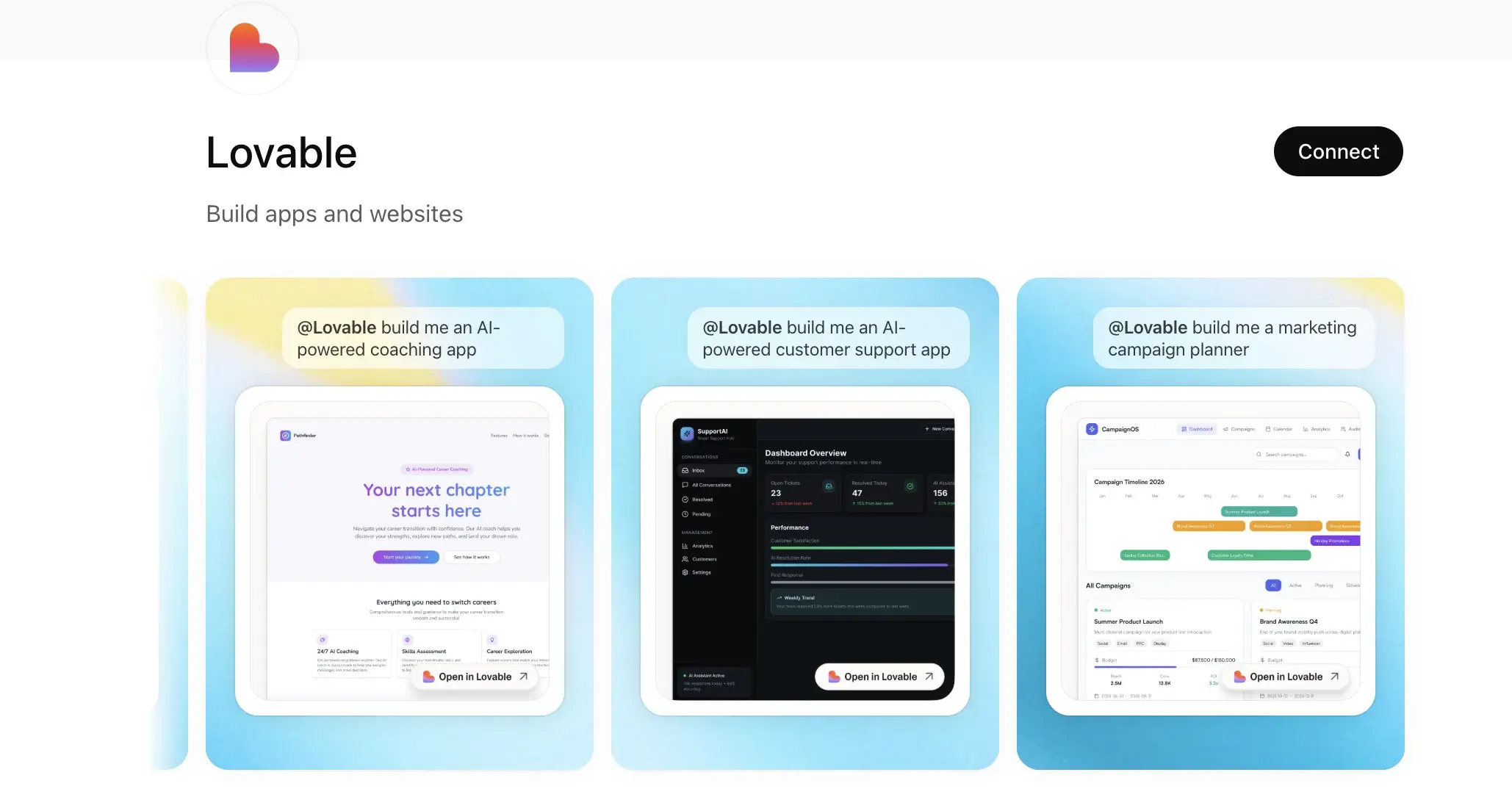
Lovable lets marketers build or "vibe code" functional web applications, such as landing pages, calculators, lead gen tools, and microsites, by simply describing what they want in plain language. This is a genuinely life-changing tool for marketers and small business owners, as you no longer need a developer to code all these assets for you. The output is real, deployable code, not a mockup.
Using Lovable's ChatGPT app just tag @Lovable inside ChatGPT, describe what you need, and it generates a fully functional, deployable web application without leaving the chat. You can preview the result directly in ChatGPT and open it in Lovable with one click. The working product will appear in the editor where it's fully editable and ready to publish.
For marketing teams, the practical value is independence. You can now ship web apps without waiting for a developer's help.
HubSpot - CRM
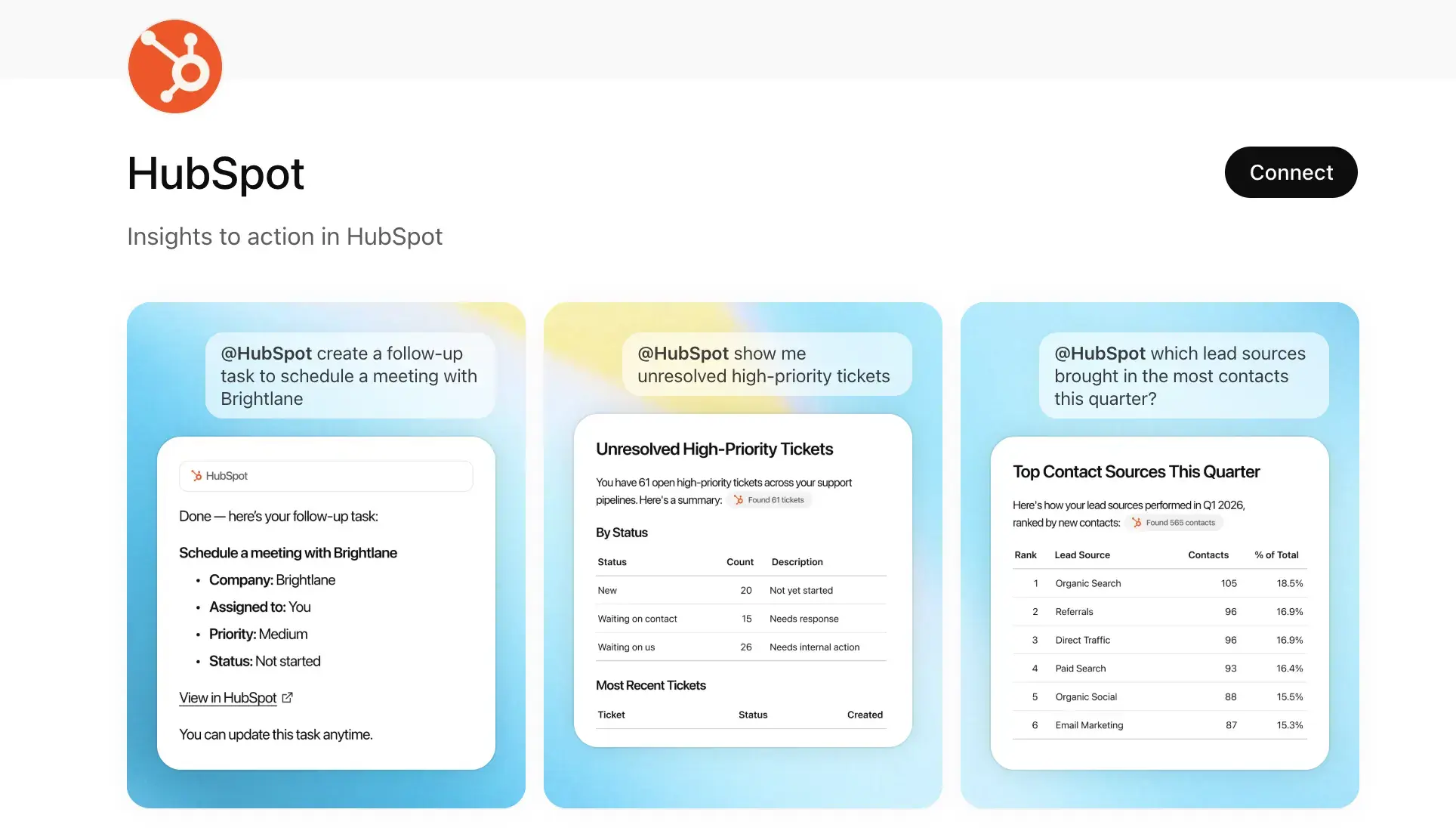
HubSpot is one of the most popular CRM tools, so there is a high chance that's where you keep your leads. HubSpot is a huge platform and is often confusing to its users. The platforms has released some AI features recently to help you automate workflows, but connecting HubSpot to ChatGPT can give you even more clarity.
HubSpot's ChatGPT app gives you full read and write access to your CRM from inside the chat. That means you can create and update contacts, move deals through pipeline stages, log calls and emails, create tasks, and pull company or ticket data in plain language, without opening HubSpot.
For marketers, the most useful scenarios are the ones that usually get neglected: reviewing pipeline details before a meeting, checking which leads haven't been followed up, or logging activity after a call while you're still in the flow of work.
Frequently asked questions
What is a ChatGPT app?
A ChatGPT app is an integration that connects ChatGPT to an external tool or service. Instead of just generating text from its training data, ChatGPT can pull live data from your actual accounts — your Ahrefs workspace, your HubSpot CRM, your Canva designs — and act on it. You find them under the Apps section in the ChatGPT sidebar.
Do all the tools in this list require paid subscriptions?
It varies. Weavely has a free plan with unlimited forms and responses. Canva has a generous free tier.Tools like Ahrefs though offer limited free access.
Do I need a paid ChatGPT plan to use apps?
Generally no. Free tier users can access and use apps from the ChatGPT App Store, including third-party integrations. The exception is if you want to build and publish your own custom app, that requires a paid plan (Plus or higher). Some premium or enterprise-specific apps may also have their own plan requirements on the vendor side.
Can ChatGPT apps act as agents?
Not on their own. A ChatGPT app is a connection to an external tool that executes when you ask it to. By itself, that's a tool, not an agent.
But ChatGPT does have an agentic mode. Give it a goal, like "research our top three competitors, pull their ranking keywords from Ahrefs, and draft a gap analysis", and it can work through the steps autonomously, deciding what to do next and calling apps along the way without you prompting each move. In that context, the apps become the hands the agent works with. The distinction is whether you're directing each step yourself or handing off the goal entirely.
Are ChatGPT apps the same as MCP integrations in Claude?
Not exactly, but they're converging. MCP (Model Context Protocol) is an open standard that multiple AI platforms now support, including Claude and increasingly ChatGPT. Some tools (like Ahrefs) have built a single MCP server that powers their integration across both platforms. OpenAI lists these as Apps regardless of the underlying protocol.

Tatiana is the Growth Marketing Manager at Weavely, where she's spent nearly four years running marketing end to end. From campaign strategy to the SEO content that brings new readers to the platform. Working day to day on a form builder gives her a front-row seat to what actually makes forms, surveys, and landing pages convert, and that's what she writes about here: practical, tested advice on lead generation and form design. Before Weavely, she led brand and SEO work at Digital Leap and cut her teeth on B2B and B2C content at Ruddy. She's based in Brussels.