How We've Built Weavely's Product Feedback Loop
Collecting feedback sounds simple. Send a few emails, add a form somewhere, wait for replies. The reality is that most tools collect too little of it, or they collect plenty but from the wrong people and end up building a roadmap based on noise.
At Weavely, we've settled on three channels for collecting product feedback: a triggered email sequence to active users, a separate sequence to churned users, and an in-product form in the dashboard. None of them are complicated. What matters more than the tools is the thinking behind who we ask.
Here's the full user feedback loop: the copy, the numbers, and what we do with everything once it comes in.
Who we ask (and who we don't)
Getting feedback is difficult, especially for self-serve SaaS products where you never speak to most of your users. But the bigger problem isn't volume. It's knowing who to ask.
Ask everyone and you collect a hodgepodge of opinions from people with completely different contexts. A user who tried your product once and left has a fundamentally different perspective than someone who uses it every week. Both are useful, but mixing them together without distinction muddies the signal.
We focus on two specific cohorts: users who have shown genuine engagement, and users who signed up but didn't come back. Everyone in between gets left out of the email sequences deliberately.
Channel 1: Email to active users
Subject line: Help me improve Weavely
The cohort: Anyone who has had 3 or more sessions on the platform in the last 30 days. These are the users who have found enough value to keep returning. They're the people most likely to have a real, grounded opinion on what's working and what isn't.
The stack: Mixpanel identifies the cohort, n8n triggers the email sequence.
The emails
Email 1:
Hi [name],
I'm co-founder of Weavely (the AI form builder you recently used). I'm reaching out to see if you have any feedback or features that you would like to see added to the product? I'm also curious to hear about the form you're building.
Thanks a lot, your feedback helps us improve!
Florian Myter
Co-Founder, Weavely
Follow-up (sent 3 days later if no reply):
Hello [name],
I just wanted to put my message back at the top of your inbox :) To avoid flooding your inbox (even more), I won't follow up again if I don't hear from you.
Kind regards,
Florian
The numbers
- 777 emails sent
- 75 replies
- 9.7% reply rate
A 9.7% reply rate on an unsolicited email asking for time and opinions is, frankly, higher than we expected. We think the tone helps. It's short, it's personal, and it's signed by a founder rather than a support alias. There's no template feel to it.
The follow-up is intentionally low-pressure. Telling someone you won't email them again if they don't respond removes friction and, we suspect, makes some people more likely to reply precisely because they feel less cornered.
Channel 2: Email to churned users
Subject line: What stopped you?
The cohort: New users who had only one session on the platform in a two-week window. They signed up, logged in once, and didn't come back. That's the churn signal we care about most. Not power users who eventually drifted, but new users who didn't get past the first impression.
This cohort tells you things active users never will. They're not emotionally invested in the product, so their feedback tends to be blunt. They also represent a decision that was made quickly: something didn't click in the first few minutes, and they moved on. That's exactly the friction you need to understand.
The emails
Email 1:
Hi [name],
I noticed you signed up for Weavely but didn't end up using it. I'm trying to understand what stopped you.
Would you be open to a quick 10-minute chat? No sales pitch, just trying to learn what went wrong so we can fix it.
If you're up for it, just reply and I'll send a calendar link.
Florian
Follow-up (sent 3 days later if no reply):
Following up on my last email. I know your time is valuable.
Would $20 and 15 minutes work? I'll send an Amazon gift card right after the call.
Just trying to understand what didn't click when you tried Weavely. Reply and I'll set it up.
Thanks,
Florian
The numbers
- 933 emails sent
- 49 replies
- 5.3% reply rate
The 5.3% rate is lower than the active user sequence, which makes sense. These people have already decided Weavely wasn't for them, so getting 1 in 20 to engage anyway is useful. The $20 Amazon gift card in the follow-up is a deliberate choice: it signals that we're serious about learning, not just going through the motions of a win-back campaign.
Channel 3: The in-product feedback form
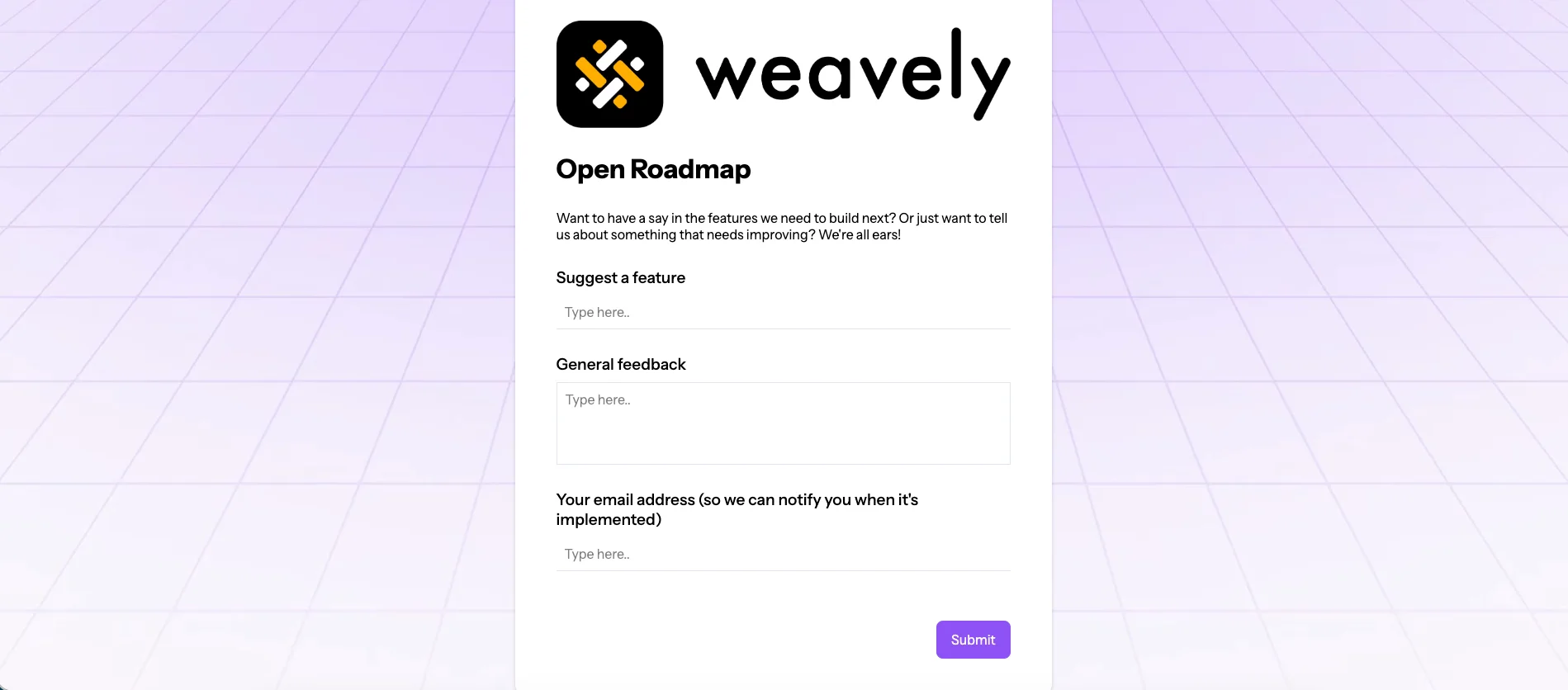
The third channel is passive. There's a "Give Feedback" button in the Weavely dashboard that opens a form we built with Weavely itself.
The form asks three things:
- Suggest a feature (short text)
- General feedback (longer text)
- Your email address, so we can notify you when it's implemented
That last field is the one people underestimate. Asking for an email in a feedback form isn't just for follow-up. It signals to the user that their input goes somewhere real and that they'll hear back. It changes the nature of the interaction from submitting a suggestion into a void to starting an actual conversation.
The numbers
- 71 submissions since June 2025
- Roughly 8 per month, unprompted
This is a different kind of signal than the email sequences. People who seek out a feedback form and fill it in without being asked are usually power users with specific requests. The volume is lower, but the intent is higher. These are people who care enough to go looking for a way to tell you something.
What happens after
All three channels feed into the same place: a Notion roadmap where we track feedback by topic. It's a simple product feedback process but it works because it's consistent. For each topic, we log who asked for it. This does two things. First, it lets us prioritise by frequency. If 12 different users have mentioned the same thing, it moves up the list. Second, it closes the loop. When we ship something that was requested, we email the users who asked for it to let them know.
That follow-up email ("we built the thing you asked for") is one of the best you can send. It's proof that the feedback process is real and not performative, and it almost always generates a positive reply.
The full picture
195 pieces of feedback. None of it collected from a generic survey blasted to everyone. If you're building a product feedback loop from scratch and want to start with one thing, start with the churn email. One cohort, one email, no tool required beyond your own inbox. The people who left are the ones most likely to tell you the truth.
Weavely is an AI-powered form builder. The feedback form mentioned in this post was built with Weavely. You can create your own here.

Tatiana is the Growth Marketing Manager at Weavely, where she's spent nearly four years running marketing end to end. From campaign strategy to the SEO content that brings new readers to the platform. Working day to day on a form builder gives her a front-row seat to what actually makes forms, surveys, and landing pages convert, and that's what she writes about here: practical, tested advice on lead generation and form design. Before Weavely, she led brand and SEO work at Digital Leap and cut her teeth on B2B and B2C content at Ruddy. She's based in Brussels.