How to Create a Self-Assessment That Works as a Lead Magnet
A self-assessment is a short set of questions that gives someone a personalized read on where they stand (their leadership style, how mature their marketing is, how close they are to burnout) in exchange for their email. It hands the respondent a moment of honest self-reflection and a clearer understanding of their own strengths and weaknesses. For coaches, consultants, and agencies, that makes it the rare lead magnet people actually want, because the result is about them. You get a qualified, engaged lead; they get insight worth the email.
This post is about the strategy: why assessments out-convert almost every other lead magnet, the two ways to score one, how to design a version people trust, and how to create it without writing a line of code. The step-by-step build lives in the video and help doc linked below. Here we focus on the thinking that separates an assessment that converts from one that gets abandoned halfway.
Why a self-assessment is the strongest lead magnet you can build
People share an email for a self-assessment because they get a personalized result about themselves in return: real insight, not a generic download. An ebook or checklist is the same for everyone; an assessment answers a question the reader is already asking about their own situation, which is why interactive tools convert far better than static ones.
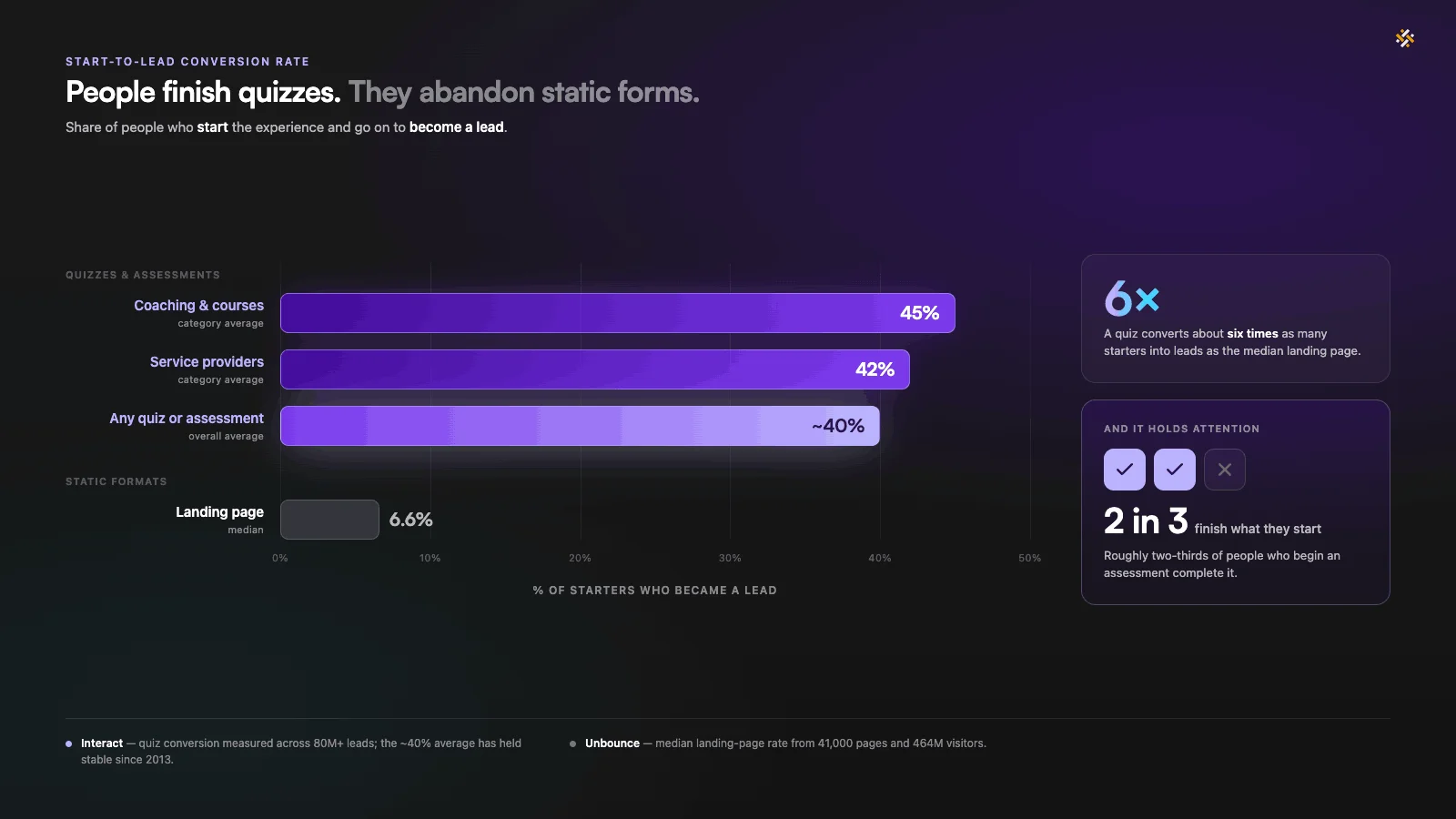
The numbers back this up. According to Interact, which has measured this across more than 80 million leads, the average quiz or assessment converts about 40% of the people who start it into leads, a rate that has stayed remarkably stable since 2013. For our world specifically, it runs higher: coaching and course businesses average around 45%, and service providers around 42%. Compare that to static formats. Unbounce's study of 41,000 landing pages and 464 million visitors found the median landing page converts at just 6.6%. Roughly two in three people who start an assessment also complete it, so the format holds attention as well as it captures leads.
There's a second, quieter advantage. The responses people give you are zero-party data, what Forrester defines as information a customer intentionally and proactively shares. A respondent telling you their team size, their biggest weakness, and their goal is a lead that has effectively qualified itself before you've spoken to them, and the data is accurate precisely because they chose to share it. You gain real insights into each lead, and you save time: the assessment filters casual browsers from the people actively looking for help, so your follow-up focuses on the leads who are ready. That's why B2B buyers, as Demand Gen Report has tracked for years, increasingly favour interactive assets like assessments over passive content. They're a two-way exchange, not a brochure.
The two ways to build a self-assessment
There are two assessment types, and picking the right one comes down to a single question: is the result a grade, or a type? If you're placing someone on a spectrum ("how mature," "how ready," "how healthy"), use a single cumulative score. If you're sorting them into a category ("what kind of X are you"), use a weighted match.
Single score (the grade-on-a-spectrum model). Every answer adds points to one running total, and score brackets map to a result. The marketing-maturity assessment in the video below is this model: the total score places someone on one of five maturity levels, each with its own tailored next-step plan. Use it when the takeaway is a level, from beginner to advanced or at-risk to thriving.
Weighted match (the type-or-archetype model). Each answer carries weight toward different categories, and the highest-weighted category wins. This is the model behind "what's your leadership style" or "which communication type are you." Use it when the takeaway is an identity rather than a level.
One thing to be honest about: the result is a single outcome, not a report card
This matters enough to say plainly, because it shapes what you promise. A self-assessment gives one overall result: a single score plus a level, or one winning category. It does not return a per-section breakdown. An assessment can ask questions across several areas (the marketing-maturity example covers website, SEO, content, email, and ads), but the result is one overall maturity level, not "SEO 7/10, content 4/10, ads 3/10."
So frame the deliverable as an overall score and level (or a category), and don't imply respondents will get a dimension-by-dimension report. Promising a breakdown you can't deliver is the fastest way to lose the trust the assessment just earned.
Self-assessment examples worth borrowing
The recipe is the same across topics; only the questions and the result change. These all work as lead magnets for service businesses because each one helps a client evaluate their own personal and professional growth and walk away with something to act on:
- Marketing maturity (single score): the worked example in the video. Questions span website, SEO, content, email, and ads; the total places the respondent on one of five maturity levels.
- Leadership self-assessment (either model): score it as a single maturity level for leadership development, or as a match that names a leadership style. Questions might probe decision making and problem-solving skills, a natural fit for coaches working on career development.
- Communication style (weighted match): answers weight toward styles like direct, analytical, or expressive, building the self-awareness that makes the dominant style worth knowing.
- Self-care or wellbeing check (single score): a cumulative read on how someone is doing, mapped to a level with tailored suggestions.
- Risk assessment (single score): a running score that places a business or project in a risk band.
Each of these is a natural standalone page targeting "[topic] self-assessment" searches, so create one well and you have a template you can repeat across topics.
How to design a self-assessment people trust
A credible assessment comes down to four choices: which questions you ask, how many, where you ask for the email, and how good the result actually is. The mechanics are easy; the judgment is where the value lives.
Choose questions that map to a real diagnosis. Each question should help you assess where someone stands and identify their genuine strengths and weaknesses, and it should move the result in a meaningful way. If an answer wouldn't change which level or category someone lands in, it's padding, so cut it. Multiple-choice questions keep scoring clean and completion high; an occasional open-ended question adds colour but slows people down, so use them sparingly. The goal is a result accurate enough to be worth acting on.
Keep it focused. Completion drops as length and confusion rise, so resist the urge to be comprehensive for its own sake. Interact's guidance is blunt about the front door, too: keep the cover title under about 15 words and the description under 25, and phrase it around something the reader actually cares about, or they'll never start.
Gate the email at the right moment. Ask for it after the respondent has invested effort but before you show the result. That's when the perceived value is highest and the exchange feels fair. Asking up front depresses starts; asking too late removes the reason to convert.
Remember where the quality comes from. This is the part no platform does for you. An AI builder can generate the structure, the logic, and the scoring in seconds, but whether the result is genuinely useful depends on your domain expertise and the prompt you write. The levels you define, the feedback you give, the next-step plan you attach to each outcome, the questions that actually discriminate between a beginner and an expert: that's your knowledge encoded into the assessment. It's also exactly what turns a score into something the respondent can use to develop and make progress, and what makes them willing to talk to you.
Build it in minutes
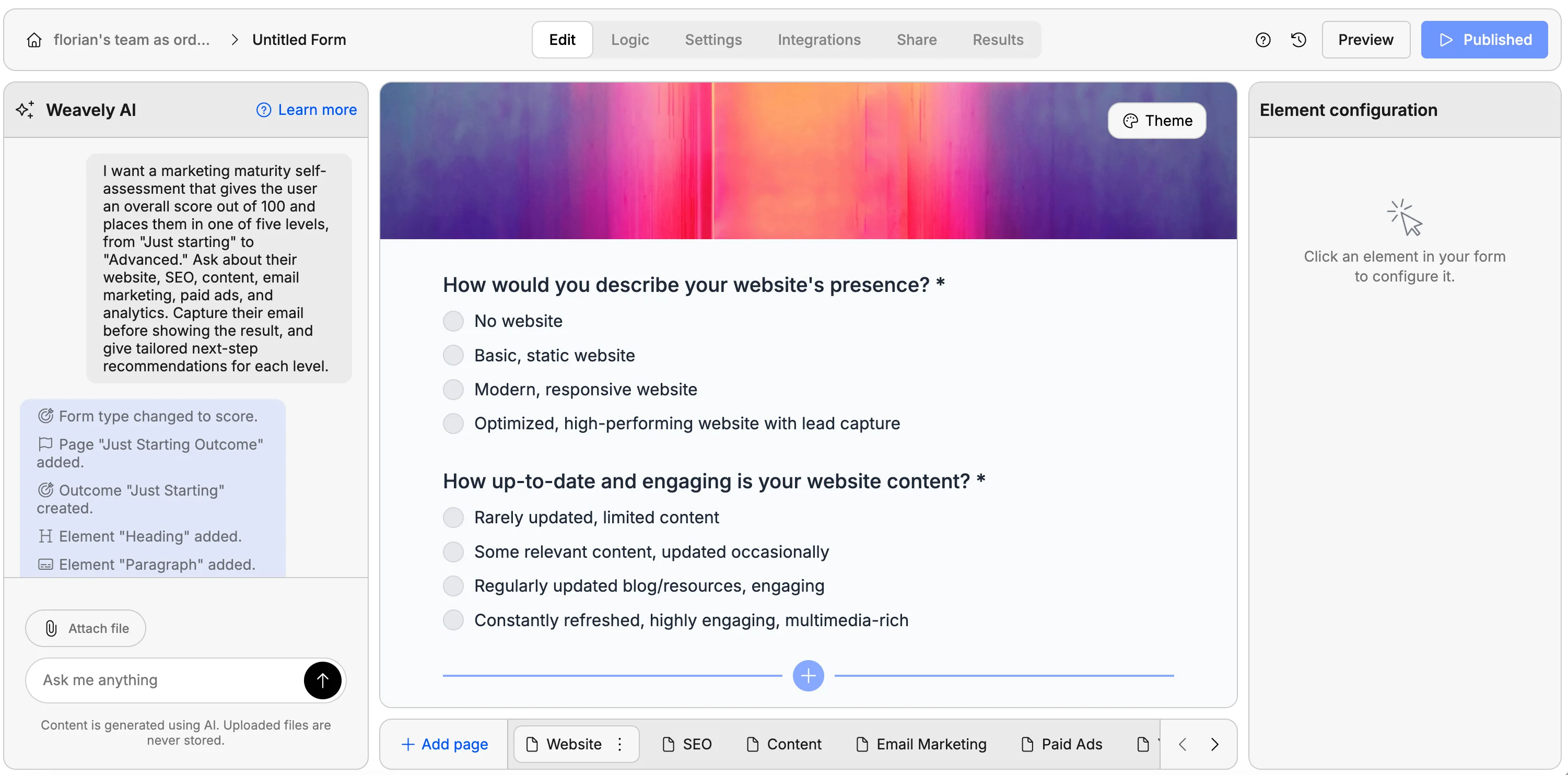
With Weavely, you describe the assessment you want in plain language and the AI builds it (questions, scoring, and result logic) in seconds. That removes the slowest part of the process and saves you the time of wiring up scoring by hand. From there you refine by prompt or edit manually, and you can add conditional logic so later questions adapt to earlier answers. Here's the prompt used in the video, as a model for your own:
text
I want a marketing maturity self-assessment that gives users an overall score
and places them on one of five levels, depending on how mature their marketing
is. Ask questions across website, SEO, content, email marketing, and paid ads.
Capture their email before showing the results, and give each level tailored
next-step recommendations.
Notice what that prompt does: it specifies the scoring model (overall score, five levels), the topics to cover, the email gate, and tailored recommendations per level. The more of your expertise you put into the prompt, the better the first draft. For the click-by-click version, see the help-desk walkthrough: Build a lead qualification form for single-score assessments, or Build a match quiz for category-based ones. It's a no-code tool that's free to build and publish, with unlimited responses on the free plan.
Collecting and using the results
Each response (the email, the score, and the result the respondent saw) is stored in Weavely, and you can route that data to your CRM or spreadsheet (Google Sheets, HubSpot, Airtable, Salesforce, and others) so leads flow straight into your follow-up. You can share the assessment as a link, embed it on your site as a pop-up or inline, or hand it out as a QR code.
FAQ
What is a self-assessment tool?
A self-assessment tool lets someone answer a set of questions and get a personalized result (e.g. a score, a level, or a category) about their own situation. Used as a lead magnet, it gives the respondent useful insight into their strengths and weaknesses and gives the business a qualified, opted-in lead.
Single score or weighted match, which should I use?
Use a single score when the result is a grade or level on a spectrum ("how mature is my marketing"). Use a weighted match when the result is a type or archetype ("what's my leadership style"). Grade means single; type means match.
Do respondents get a score for each section?
No. A self-assessment returns one overall outcome: a single score and level, or one winning category. Even if its questions cover several areas. It doesn't produce a section-by-section breakdown, so don't design your promise around one.
How long should a self-assessment be?
Long enough to produce a credible result, short enough to complete. Every question should change the outcome; if it doesn't, cut it. Completion rates fall as assessments get longer or more confusing.
Is it free to build one?
Yes, Weavely's free plan includes unlimited forms and responses, with a small "made with Weavely" badge on the result.
Ready to build yours?
Describe your assessment in a sentence and let Weavely build it. Try Weavely for free: unlimited responses, no code, and your first version live in minutes.

Florian is the co-founder and CEO of Weavely, where he does a bit of everything: from product and fundraising to making YouTube videos and writing for the blog. He holds a PhD in computer science and sits on the board of No Code Belgium, the country's no-code community, after more than seven years as a researcher and business developer at Vrije Universiteit Brussel. He writes the hands-on tutorials here, drawing on both an academic background and the day-to-day reality of building a form tool from the ground up. Based in Brussels.