Growth Marketing Experiment: We Sent 150 Handwritten Letters to B2B Prospects
We're a B2B startup. We don't do cold outreach. We're product-led, organic-first, and generally allergic to anything that smells like spam.
So naturally, we spent €705 and 59 hours sending handwritten letters to 150 strangers.
Here's why, what happened, and whether this growth marketing tactic is actually worth it. All the numbers included, even the ones that make us look silly. Consider this one of those marketing case studies where the honesty is the whole point.
Why We Tried This Guerilla Marketing Tactic
Like most people with an inbox, we get a lot of cold outreach. And lately, it's gotten noticeably worse. AI-generated emails that open with "I noticed your company is doing amazing things in the [INDUSTRY] space." You know the type. Half the time they don't even fill in the brackets.
Cold outreach as a channel is being destroyed by AI spam. The average cold email reply rate has dropped to around 3.4%, down from 5.1% the year before. About half of people say they don't engage with cold emails at all. That tracks with what our own inboxes look like.
We rarely do outbound. Weavely is an AI-powered form builder. People find us, try the product, and either stick around or don't. But we wanted to run a marketing experiment: what's the absolute opposite of a lazy AI-blasted cold email? What's the least spammy thing you could possibly send someone?
A handwritten letter felt like the answer.
The B2B Direct Mail Experiment Setup
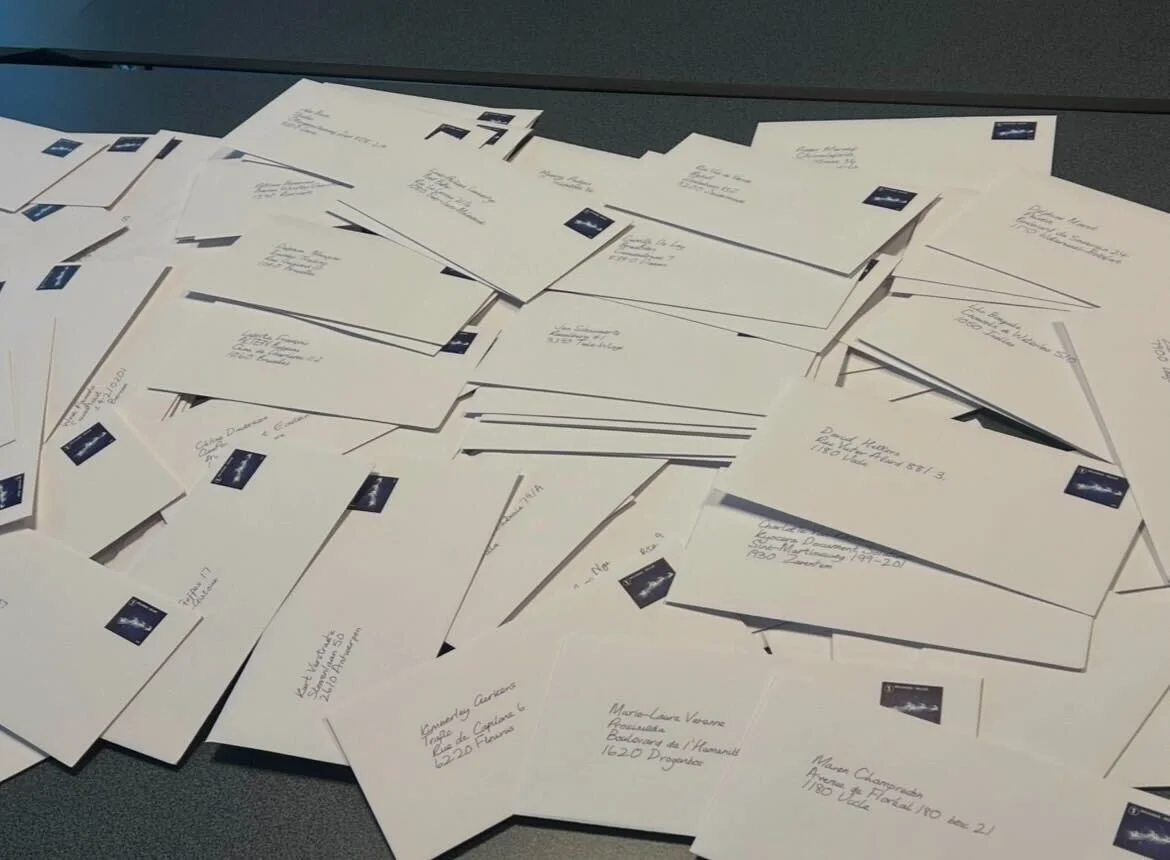
We sent 150 handwritten letters to people in Belgium, divided into three groups of 50:
Group 1: Entrepreneurs. Founders and startup operators, especially in digital. We already knew from our user base that these people are a good fit for Weavely.
Group 2: Growth Marketers. Mostly freelancers. Same logic. Marketers who build forms and surveys regularly.
Group 3: HR Ops (the long shot). HR operations people at large Belgian corporates. We had less evidence this group would care about a form builder, but we wanted to test a wider net.
For entrepreneurs and freelance marketers, we used the KBO (Belgium's national company registry) to find home addresses from incorporation documents. Freelancers in Belgium typically register their home as their business headquarters, so these addresses are public record. We used LinkedIn to identify targets and Bizzy.ai to cross-reference company info.
For HR Ops, we couldn't find home addresses (they work at large corporates), so we sent letters to the office most likely to be theirs.
The whole setup (finding a handwriting service, sourcing targets, looking up addresses in legal documents) took us all of November. We sent the letters in a single batch in mid-December.
Our Handwritten Letter Template and Strategy
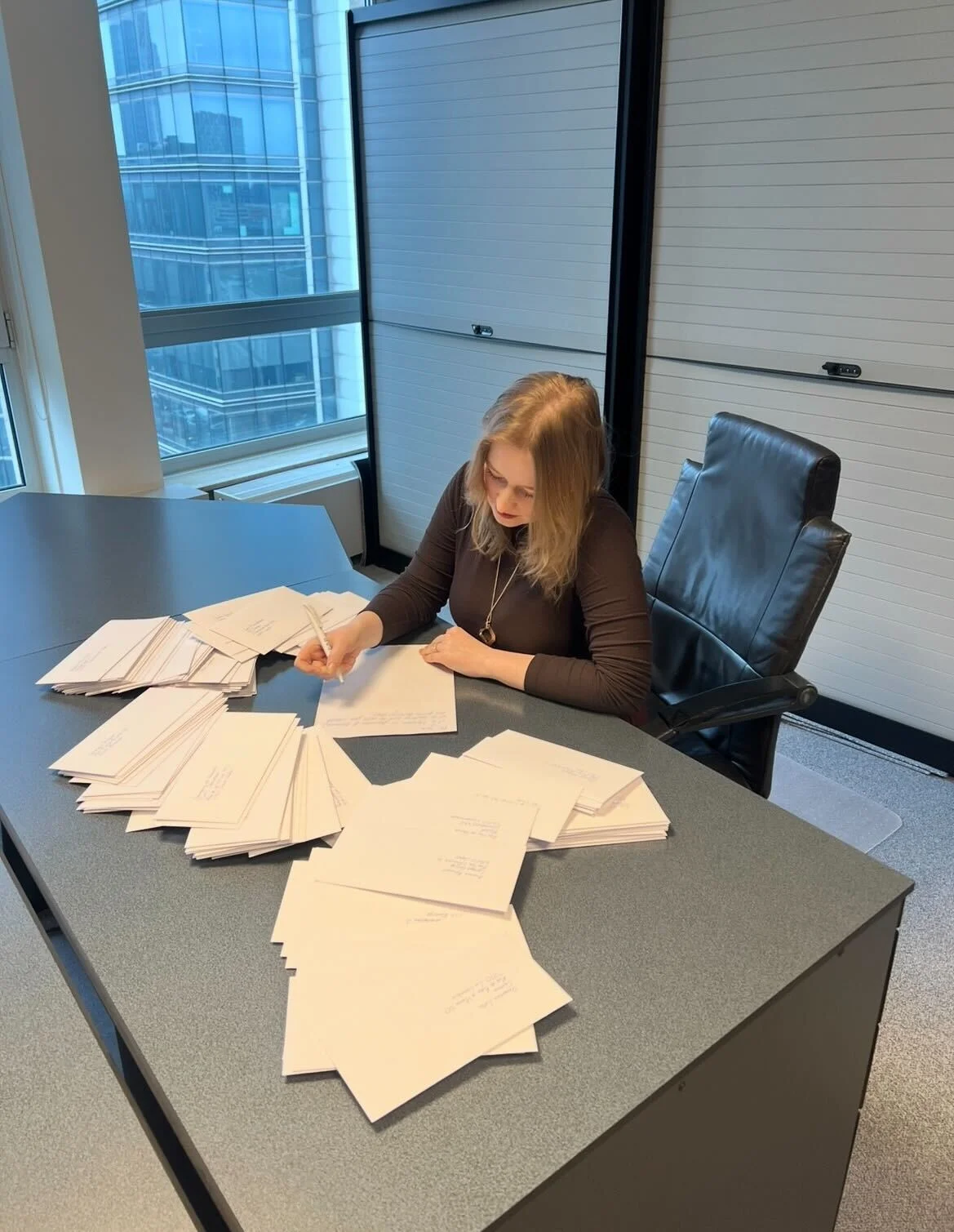
We used a service called RoboQuill to produce the letters. The handwriting looks genuinely human. If you look closely, you might notice the lines are slightly too straight and the spacing is a bit too consistent. But the goal wasn't to fool a forensic analyst. It was to show that we put in more effort than a mass email.
The envelopes were plain, with addresses handwritten by RoboQuill too. We figured the envelope is the first thing people see. A branded envelope screams "marketing mail" and goes straight in the trash.
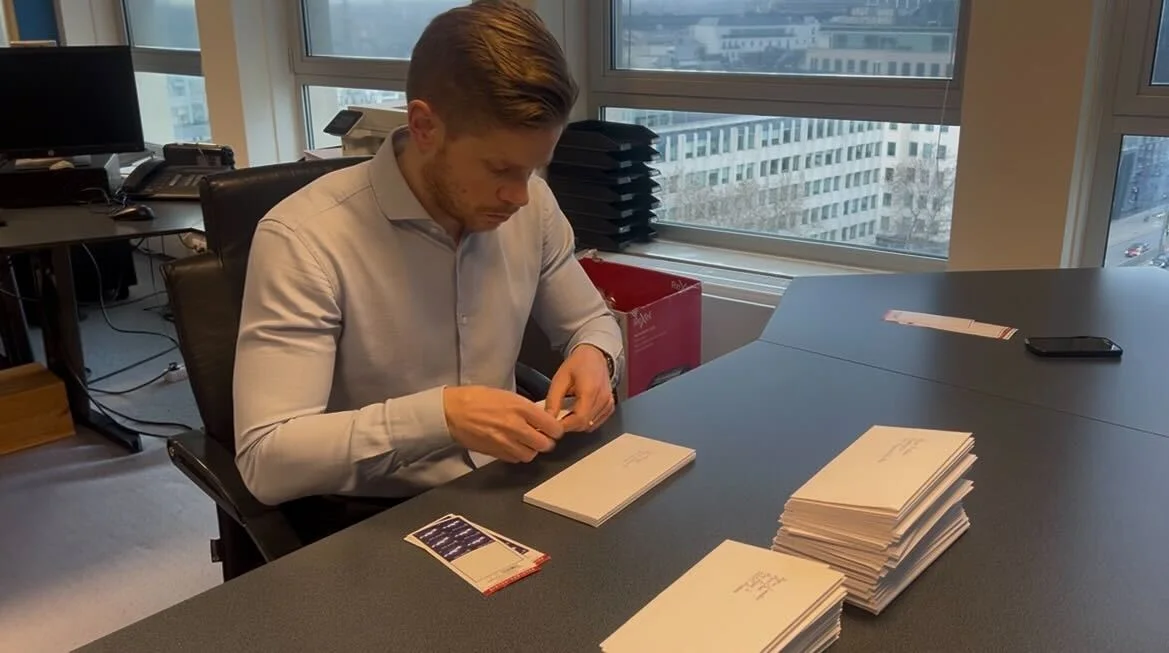
Inside each envelope: the letter itself, plus a personalized business card that said "Hey [Name], we've built you an example form" with a QR code linking to a custom Weavely form in the recipient's brand colors.
Here's what the letter said:
Hi Luca,I'm Florian, co-founder of Weavely. I know it's a bit unusual to get a handwritten note these days. I just wanted to send you something more personal than another email in your inbox.
You're probably expecting a pitch. I would be lying if I said it isn't coming. However, I'm not really selling you anything. I'm building a (mostly) free AI-powered form builder. It would be great if you would try it next time you need a form or survey!
I've generated an example form for you. You can access it by scanning the QR code attached to this letter.
Kind regards,Florian Myter, Co-founder of Weavely.ai
Personalization was minimal: just the recipient's name on the letter and the brand-colored form behind the QR code. Everything else was identical across all 150 letters. As far as personalized outreach goes, we could have done a lot more.
The Results: Response Rates vs Cold Email
Let's get to the numbers.
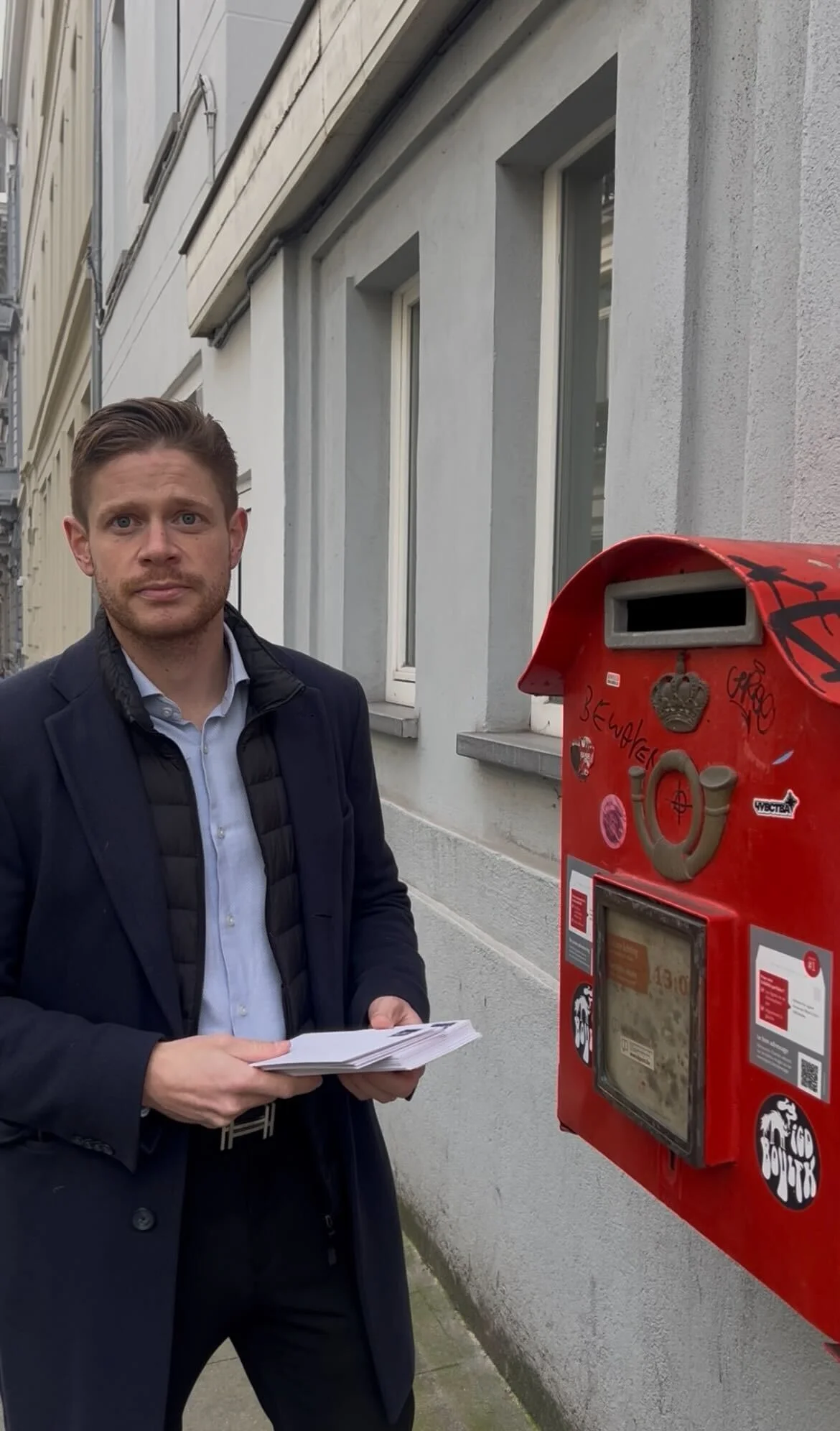
Out of 150 letters:
- 22 people scanned the QR code (14.7% scan rate)
- 1 person reached out on LinkedIn
- 3 people started following us on LinkedIn
- 0 people signed up for Weavely
The scan rates varied dramatically by segment:
Now, how does that compare to cold email?
A QR code scan on a physical letter is closest in behavior to clicking a link in a cold email. The person has to take a deliberate action to engage further. Here's how the channels compare on that metric:
A 14.7% engagement rate (20% for the segments we actually targeted well) looks strong on paper. That's 4-7x the typical cold email click rate.
But there's a big asterisk here: zero conversions. Nobody signed up. Nobody started a trial. One person messaged us on LinkedIn, and she noted that she could tell the letter wasn't genuinely handwritten (though she appreciated the effort). She also asked how we got her address.
What Surprised Us About This Growth Marketing Experiment
The good: A 20% scan rate for the right audience is legitimately impressive. When you send something physical and personal to someone who's used to digital noise, they notice. Direct mail benchmarks hover around 4.4% response rates. We beat that by 3x for our targeted groups.
The bad: Sourcing the data was brutal. We estimated it would take a few hours. It took 40. Digging through Belgian company registration documents to find home addresses, cross-referencing LinkedIn profiles with KBO records, verifying that freelancers still lived where they'd registered their business. It was tedious, manual work that doesn't scale.
The ugly: Despite 22 people scanning our QR code and seeing a personalized form in their brand colors, none of them actually tried Weavely. The letter created awareness and a brief moment of curiosity. It did not create customers.
When Handwritten Letters Make Sense for B2B Marketing
After running this experiment, here's our honest take on where personalized outreach like this works and where it doesn't. There are plenty of b2b marketing tactics that sound creative but fall apart in practice. This one is more nuanced.
It probably works well if:
- You're in a sales-led GTM motion where a single meeting can justify the cost
- Your average deal size is high enough (think €5,000+ ACV) to absorb the expense
- You're targeting founders or CEOs at smaller companies, where you can reach them directly at home
- You plan to follow up with warmer outreach afterward (LinkedIn, email, phone). The letter warms the lead, and you close through another channel
- You're doing account-based marketing with a small, high-value target list
It probably doesn't work if:
- You're product-led like us, where the whole model depends on people signing up and trying the product on their own
- Your price point is low or free (hard to justify €4.70+ per letter when conversion is uncertain)
- You need scale. This approach maxes out at maybe a few hundred letters before the time investment becomes impractical
- You're targeting people at large companies where letters go to a mailroom, not a person's desk
For Weavely, being a mostly-free, product-led form builder? This was the wrong channel for the wrong business model. But if you're running a B2B sales-led startup and selling contracts worth thousands per year, handwritten letters could be a solid creative marketing tactic, especially as the opening move in an ABM sequence.
The Real Cost: Time, Money, and Scalability
Here's the full cost breakdown for 150 letters:
Direct costs:
Time investment:
Unit economics:
- Cost per letter (direct only): €4.70
- Cost per QR scan (direct only): €32
- Cost per letter (including time at €50/h): €24.40
- Cost per QR scan (including time): €166
For comparison, the average cost per unit for a direct mail piece runs between €0.30 and €3. We were above that, partly because of the handwriting service and partly because we personalized every business card and form individually.
The 59 hours is what really kills the economics. Forty of those hours were spent on data sourcing alone. If you have an existing CRM with physical addresses or you're working in a market where business addresses are easier to find, this number drops dramatically.
Key Takeaways for Growth Marketers
1. The channel works. Our targeting didn't (for us).A 20% engagement rate proves that handwritten letters cut through noise. The problem wasn't the tactic. It was that we used an awareness channel for a product that needs self-service adoption.
2. Audience matters more than medium.Entrepreneurs and marketers engaged at 20%. HR people at large corporates? 4%. Same letter, same effort, five times the difference. Know your audience before you invest in creative b2b marketing ideas.
3. Data sourcing is the hidden cost.Everyone talks about the cost per letter. Nobody talks about the 40 hours spent finding addresses. If you're considering B2B direct mail, start by asking yourself: do I already have physical addresses for my targets? If not, budget serious time for it.
4. Handwritten letters are a top-of-funnel play.This is awareness, not conversion. If you're planning to use this tactic, pair it with follow-up outreach. The letter opens the door. You still need to walk through it via LinkedIn, email, or phone.
5. The math only works at certain price points.At €32 per engaged prospect (direct costs only) or €166 all-in, your customer lifetime value needs to justify that spend. For a free product-led tool like Weavely, it doesn't. For a B2B SaaS product with €10K+ ACV? That's a reasonable customer acquisition cost.
6. It was fun, and that matters too.Not every marketing experiment needs to be a home run. We learned something, we have data, and we got to do something genuinely different. In a world of AI-generated everything, sometimes the most creative marketing move is doing something that clearly took effort, even if the ROI doesn't justify doing it again.
This experiment was run by Florian Myter, co-founder of Weavely, and Tatiana Shpyleva, Growth Marketer at Weavely.
Weavely is an AI-powered form builder that generates custom forms from natural language prompts. You describe what you need, and the AI builds it in seconds. No templates, no drag-and-drop. It's mostly free.
Tatiana is the Growth Marketing Manager at Weavely, where she's spent nearly four years running marketing end to end. From campaign strategy to the SEO content that brings new readers to the platform. Working day to day on a form builder gives her a front-row seat to what actually makes forms, surveys, and landing pages convert, and that's what she writes about here: practical, tested advice on lead generation and form design. Before Weavely, she led brand and SEO work at Digital Leap and cut her teeth on B2B and B2C content at Ruddy. She's based in Brussels.