How to Convert Google Docs (or Word Files) to Google Forms with AI
Ever spent hours crafting the perfect set of questions in a Google Doc … only to realize you now have to copy-paste every single one into a Google Form? Yeah, we’ve all been there. It’s a universal pain point for teachers, marketers, researchers, and anyone who’s ever thought, “Surely Google could automate this by now?” Well, good news: you actually can convert docs to Google Form. And yes, you've guessed it, AI is coming to your rescue!
In this guide, I'll show you three simple methods to turn any document (Google Doc or Word .docx file) into a ready-to-use form:
- The lightning-fast Weavely AI converter (paste your link → boom → instant form).
- The brand-new Weavely Google Docs add-on (generate a form without ever leaving your doc).
- The AI Form Builder add-on for Google Forms (free limited usage, if you need a real Google Form).
By the end, you’ll know exactly which one suits you best, and you’ll never have to rebuild forms from scratch again. Oh, and if you're feeling lazy and don't want to read, we have you covered with a video as well!
Why Convert Docs to Google Forms?
Let’s start with the “why” before the “how.”
Many people draft their survey or quiz questions in word documents first. It’s easier to collaborate, comment, and edit. But once it’s approved, that same content needs to become an actual Google Form so you can collect answers, analyze data, and maybe even add a “correct answer” or two for automatic grading (i.e. Google Form Quiz).
Unfortunately, there’s no built-in “Convert Doc to Google Form” button in Google Drive (seriously, Google?).
So instead, we’ll use one of two clever workarounds using AI tools. Working from a PDF instead? Here's how to turn a PDF into a form.
Method 1: Convert a Google Doc to a Form with Weavely AI Form Builder (Fast & Free)
This is the easiest method by far. Technically, it doesn’t produce a Google Form; it creates a Weavely form, which behaves the same way (unlimited responses, sharable links, form logic, themes, etc.). Think of it as Google Forms that went to design school. Here are three simple steps to get started:
Step 1: The Weavely Doc-to-Form Converter
It doesn't get much easier than this. Weavely has a page dedicated to converting word documents into web forms, you can open the Weavely Doc-to-Form converter directly.

Paste the link to your Google Doc, or upload a Word (.docx) file, then hit the big old "Generate form" button. If you're using a Google Doc link, make sure you've selected "Anyone with the link" in the share options first. Weavely's AI will then analyze your document and generate a form which will automatically open in a new tab. Take into account an approximate 60 seconds for the process to complete.

And voilà! You’re now inside the Weavely Form Editor. Everything from your doc (e.g. all the questions, options, even tone of phrasing) has been transformed into a form. The AI will automatically determine ideal question types unless you explicitly state them.
In our test example, we had a question like “How old are you? Between 12 and 99”. Sure, the AI turned it into a dropdown that includes 88 possible ages (which… is technically accurate). But that’s the fun part: you can adjust the field type, labels, and choices directly in the editor.
Weavely also read another question “Your favorite car brands?” and automatically generated a multiple-choice list with real car brands. It even detected a “rate this” line and turned it into a star rating question.
If you’ve ever tried doing that manually in Google Forms, you know how satisfying this is.
Step 2 (Optional): Customize the Design
Now here’s where Weavely shines compared to traditional Google Forms.
You can:
- Pick from pre-made templates (from clean and minimal to neon and funky).
- Change the theme with AI (“Make it look like a tech conference survey”).
- Add images, logic jumps and custom thank-you pages.
- Integrate with Google Sheets or other tools to gather your responses.
Basically, you’re getting a more flexible, unlimited version of Google Forms. One that also looks like it was designed this decade.

Step 3: Publish the Form
That's it, you're all set. Simply hit the big blue "Publish" button at the top of the form and you can share your form or embed it into your website!
Why Choose the Weavely Method?
Here are some of the pros and cons of using this method to create forms from your word documents:
- ✅ Fastest option: a few clicks, 60 seconds tops and you're done!
- ✅ Unlimited file uploads
- ✅ Customizable: change layout formats, fonts, colors any way you see fit to have a form that matches your brand.
- ❌ Weavely doesn't generate Google Forms, but for 99% of the cases it behaves the same.
Method 2: Convert a Google Doc to a Form with the Weavely Google Docs Add-On (No Copy-Pasting)
Love the speed of Method 1 but practically live inside Google Docs all day? Then this one's for you. We recently launched the Weavely Google Docs add-on, a free Google Docs add-on that turns your document into a form without you ever leaving the page.
No copying share links, no switching tabs, no fiddling with permissions. You open your doc, click a button in the sidebar, and a few seconds later you've got a working form. It's the same free, unlimited Weavely form you'd get from Method 1, except you generate it right where you're already writing.
If you've been digging through the Google Workspace Marketplace for a "doc to form" add-on, this is the one.
Step 1: Install the Add-On from the Google Workspace Marketplace
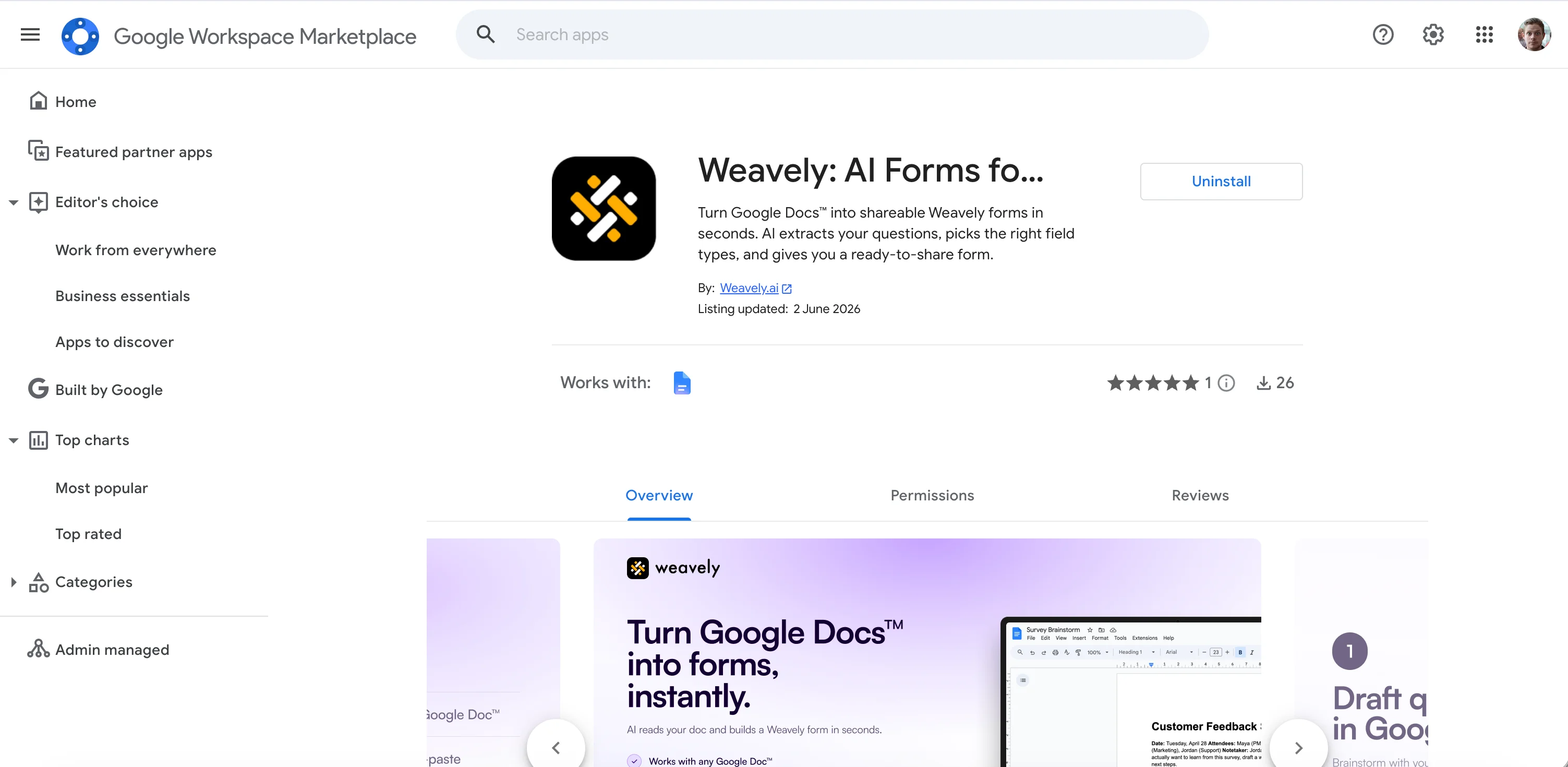
Head into the Google Workspace Marketplace and search for Weavely or AI forms for Google Docs (or just click the link we've dropped for you 😉). Hit the Install button, sign in, and approve the permissions screen you're probably already familiar with. Once that's done, the add-on (sometimes called a Google Docs extension) is installed across your Workspace and ready to use.
Step 2: Open Your Doc and the Weavely Sidebar
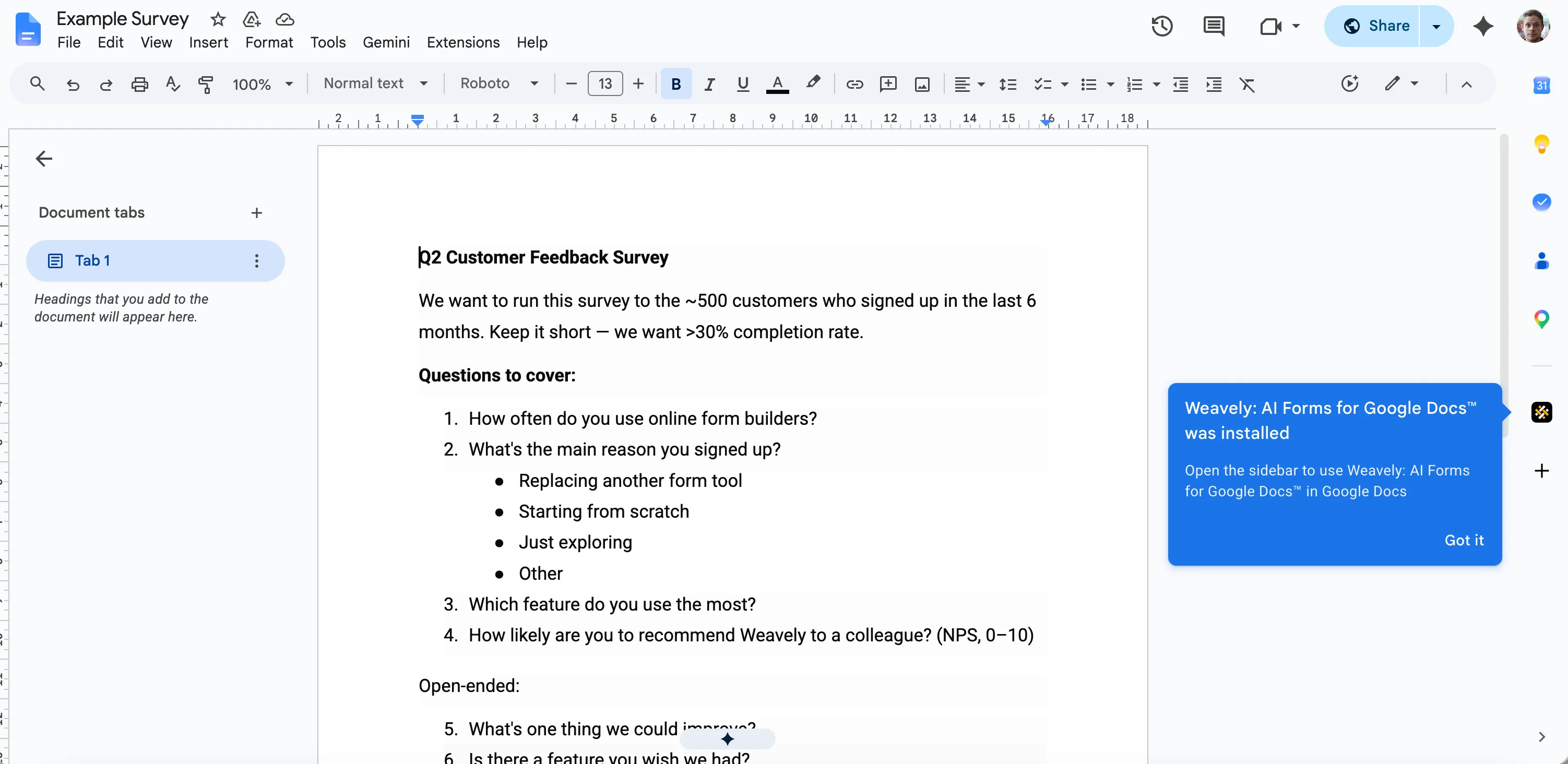
Open any Google Doc (your survey brainstorm, your quiz questions, a product brief, literally anything with content in it) and you'll see the Weavely icon appear in the right-hand sidebar. Click it to open the add-on.
Quick privacy note, because we know it matters: the add-on asks for permission on a per-file basis. It only ever reads the specific document you're working in, not your entire Drive.
Step 3: Generate Your Form
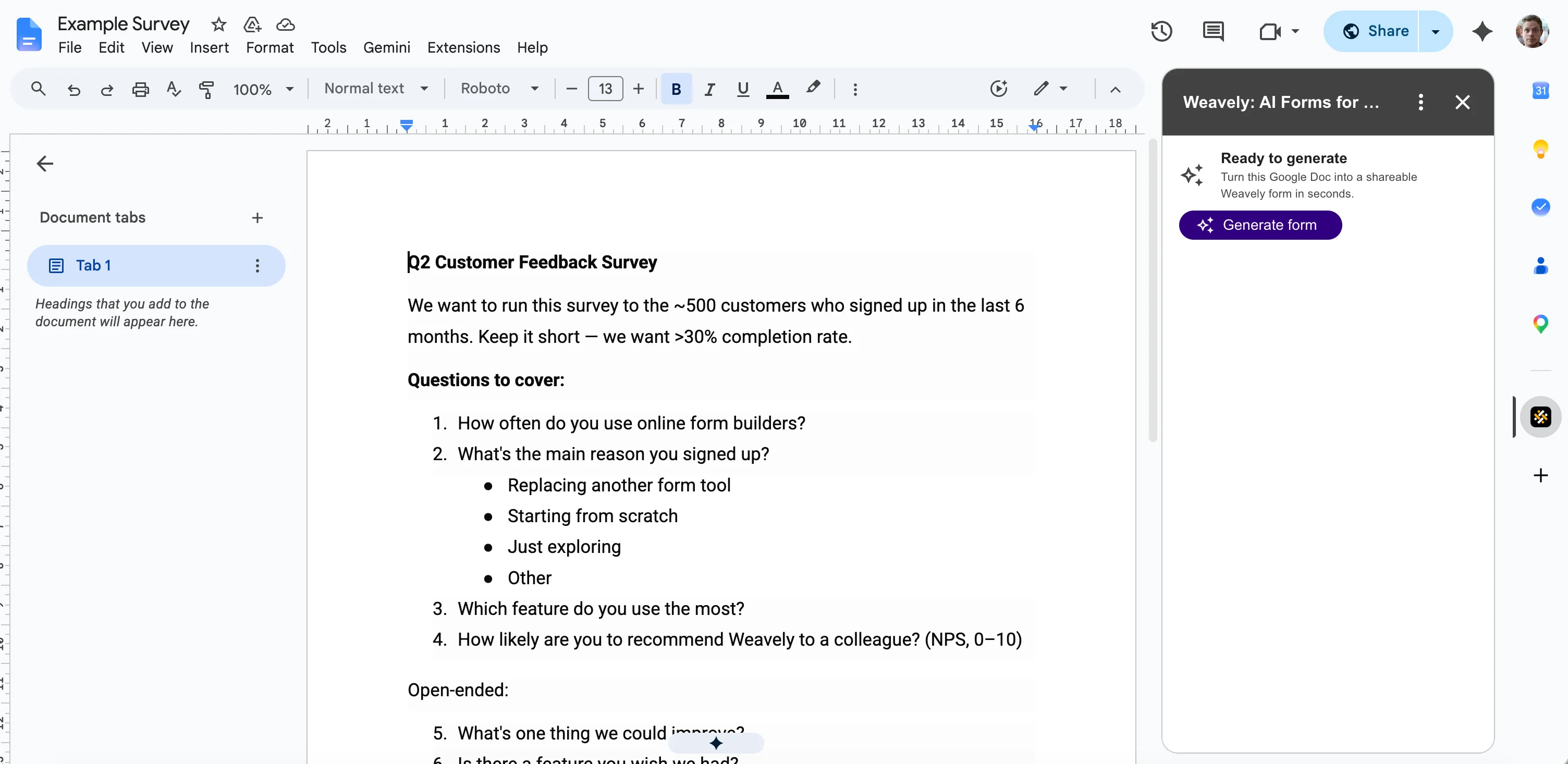
Hit the big Generate Form button and let it run. Weavely reads through the content of your Google Doc and builds the form on the spot. It pulls the title, carries over the extra context you've written, and turns each question into the right field type (multiple choice, dropdowns, rating scales, open text, and so on). As always: the better structured your doc, the better the output, but even rough notes work surprisingly well.
In our example, a customer feedback survey we'd brainstormed with the team, it got almost everything right out of the box. The one miss? A "likelihood to recommend" question it set to a 1–5 scale when we actually wanted 1–10. Which brings us to the best part…
Step 4: Tweak It by Chatting with the AI
Don't like something? Just tell the AI. We typed "the recommend score should be a 1 to 10 scale, not 1 to 5" and it updated the field instantly, no menu-digging required.
Want to go further? Ask for conditional logic in plain English. We said "only show the main reason question when someone typed an answer in the first question," and the add-on wired it up automatically, with no logic-builder and no figuring out how to make it work. Hit the Preview button to play with the live form and double-check everything behaves the way you'd expect before you ship it.
Step 5: Publish and Share
When you're happy, press Publish. If you're already signed in, you instantly get a shareable URL. No account yet? Creating one is free, and comes with unlimited forms and unlimited responses. From there you can copy the link and send it around, embed the form on your website, or share it on social media.
Every response lands inside your Weavely dashboard, where you can download submissions as a PDF or send the data straight to Google Sheets (we've got other tutorials on those integrations too).
Why Use the Google Docs Add-On Method?
Here's how this method stacks up:
- ✅ Zero copy-pasting: it works right inside Google Docs, where you're already writing
- ✅ No share-link fiddling: unlike the web converter, you never have to set the doc to "Anyone with the link"
- ✅ Free with unlimited forms and responses: no paywall on the essentials
- ✅ Per-file permissions: it only reads the doc you open, not your whole Drive
- ✅ Edit by chatting with AI, add logic, preview, and publish without ever leaving your workflow
- ❌ Just like Method 1, it creates a Weavely form, not a native Google Form, though for ~99% of use cases it behaves exactly the same (and looks a lot better).
Add-On vs. Web Converter: Which Weavely Method Should You Use?
Both are free and both produce the same Weavely form, so you can't really go wrong. The short version:
- Use the web converter (Method 1) for a quick one-off when you've already got a share link ready to paste.
- Use the Google Docs add-on (Method 2) if you live in Google Workspace and convert docs to forms regularly. It's faster day-to-day because you never leave the document or touch a share setting.
Method 3: Using the AI Form Builder Add-On
Now, if you absolutely need a real Google Form (for example, you’re tied to Google Workspace), there’s another option: the AI Form Builder add-on inside Google Forms.
This method is somewhat more time consuming, but it definitely also gets the job done. Quick heads-up so you don't mix these up: the AI Form Builder add-on below is a separate, third-party tool. It's not the Weavely Google Docs add-on from Method 2. The key difference is what each one produces. Weavely's add-on lives inside Google Docs and creates a free, unlimited Weavely form, while this AI Form Builder add-on lives inside Google Forms and generates a native Google Form. So if you specifically need a real Google Form, for example because you're tied to Google Workspace, this is the method for you.
Here are the steps you need to follow to use this method:
Step 1: Install the Add-On

Within the Google Forms editor (i.e. not the dashboard), open the three-dots menu and click on "Get Add-ons" as shown in the screenshot above. Search for AI Form Builder in the google workspace marketplace (or simply click the link we provide you 😉) and go through the installation wizard.
Step 2: Launch the Add-On
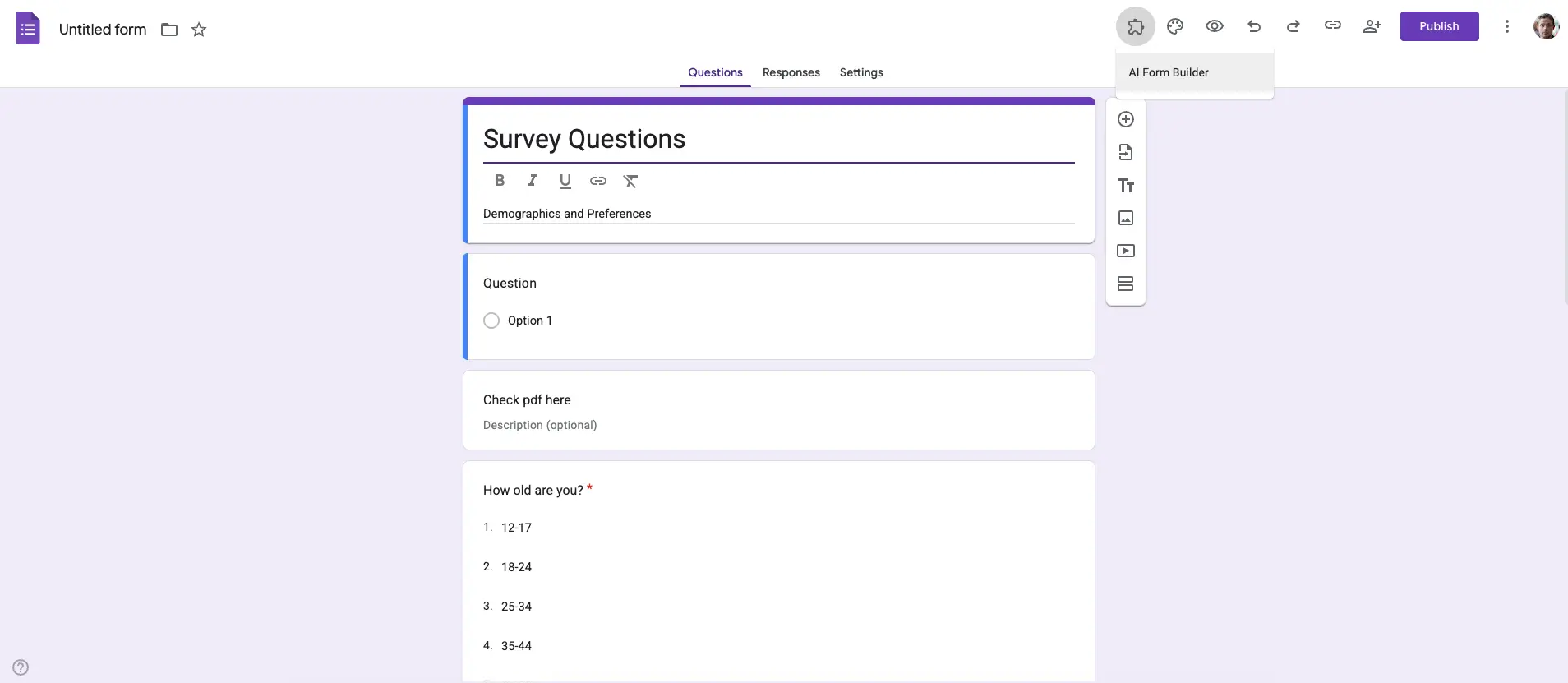
Once installed, click the puzzle icon → select AI Form Builder → Open. You’ll see a sidebar appear on the right side of your screen.
Step 3: Select The Doc from Your Google Drive & Let the Magic Happen
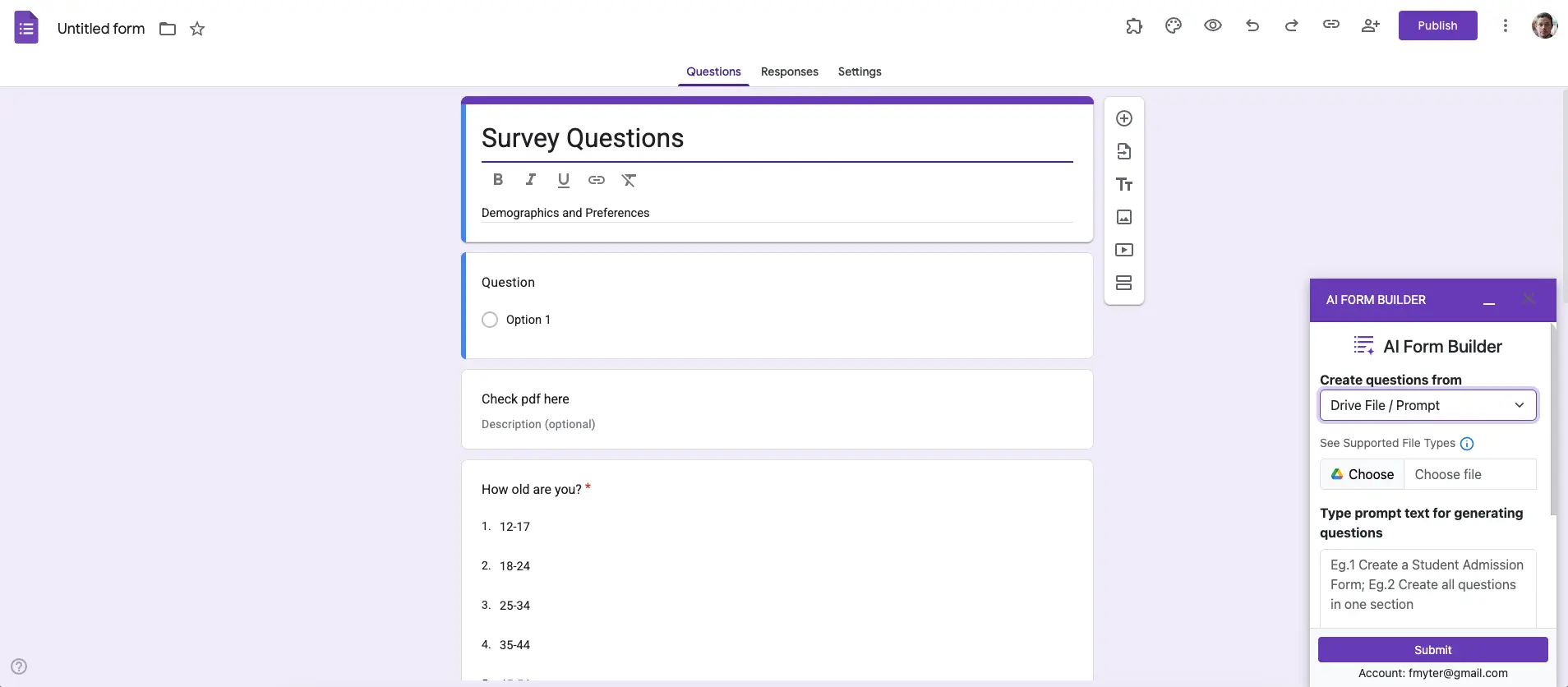
Inside that sidebar, choose where to pull questions from. Select “From Drive,” then find the same Google Doc you used earlier (i.e. your brainstorm, quiz, survey questions, etc.). Once you hit the purple "Submit" button the add-on will analyse the content of your word doc and automatically generate questions inside your Google Form (e.g. multiple choice questions, drop down menus, short answers, etc).
Free Tier Limitations of the Add-On
Unfortunately the add-on only offers a limited number of conversions. Also unfortunately the add-ons website is currently unclear as to how many conversions you get for free. If you only need one you don't need to worry about upgrading. Otherwise the cheapest tier currently starts at $7 per month.
Frequently Asked Questions
How to Convert a Google Doc to a Google Form?
To convert a Google Doc to a form, you have three options: paste your doc link into Weavely's free Doc-to-Form converter, use the free Weavely Google Docs add-on to build a form without leaving your document, or install the third-party AI Form Builder add-on if you specifically need a native Google Form. All three turn your document into a ready-to-use form in minutes.
Can I convert a Doc with Images or Tables into a Google Form?
Yes, but with a few caveats. When you convert a doc to Google Form, the AI focuses mainly on text-based questions. Images, tables, or charts may not be imported automatically, but you can re-add them manually afterward inside your form editor.
Does Weavely Have a Google Docs Add-On?
Yes. The Weavely Google Docs add-on is free and installs from the Google Workspace Marketplace. Just search "Weavely" or "AI forms for Google Docs." A Weavely icon then appears in your Docs sidebar, and one click turns the doc into a ready-to-share form.
Is the Weavely Doc-to-Form Add-On Free?
Yes, it's free, with unlimited forms and responses. Unlike the AI Form Builder add-on for Google Forms ($7/month after a small free tier), Weavely only needs a free account to publish and share.
Is Weavely AI Free?
Yep! Weavely’s Doc-to-Form converter is completely free and has no generation limits. You can create as many forms as you want.
Can I use an Add-On to Convert a Doc to Google Form directly in Google Drive?
Absolutely. The AI Form Builder add-on for Google Forms lets you convert your doc directly within the Google ecosystem. Once installed, you can import your Google Doc right into a Google Form without leaving Drive. It’s great for educators and teams who need forms saved in their shared Drive.
Can I Convert a Word Document (.docx) to a Form?
Yes. Weavely's Doc-to-Form converter lets you upload a Word (.docx) file directly, or paste a Google Doc link. Either way the AI reads your document and builds the form for you.

Florian is the co-founder and CEO of Weavely, where he does a bit of everything: from product and fundraising to making YouTube videos and writing for the blog. He holds a PhD in computer science and sits on the board of No Code Belgium, the country's no-code community, after more than seven years as a researcher and business developer at Vrije Universiteit Brussel. He writes the hands-on tutorials here, drawing on both an academic background and the day-to-day reality of building a form tool from the ground up. Based in Brussels.